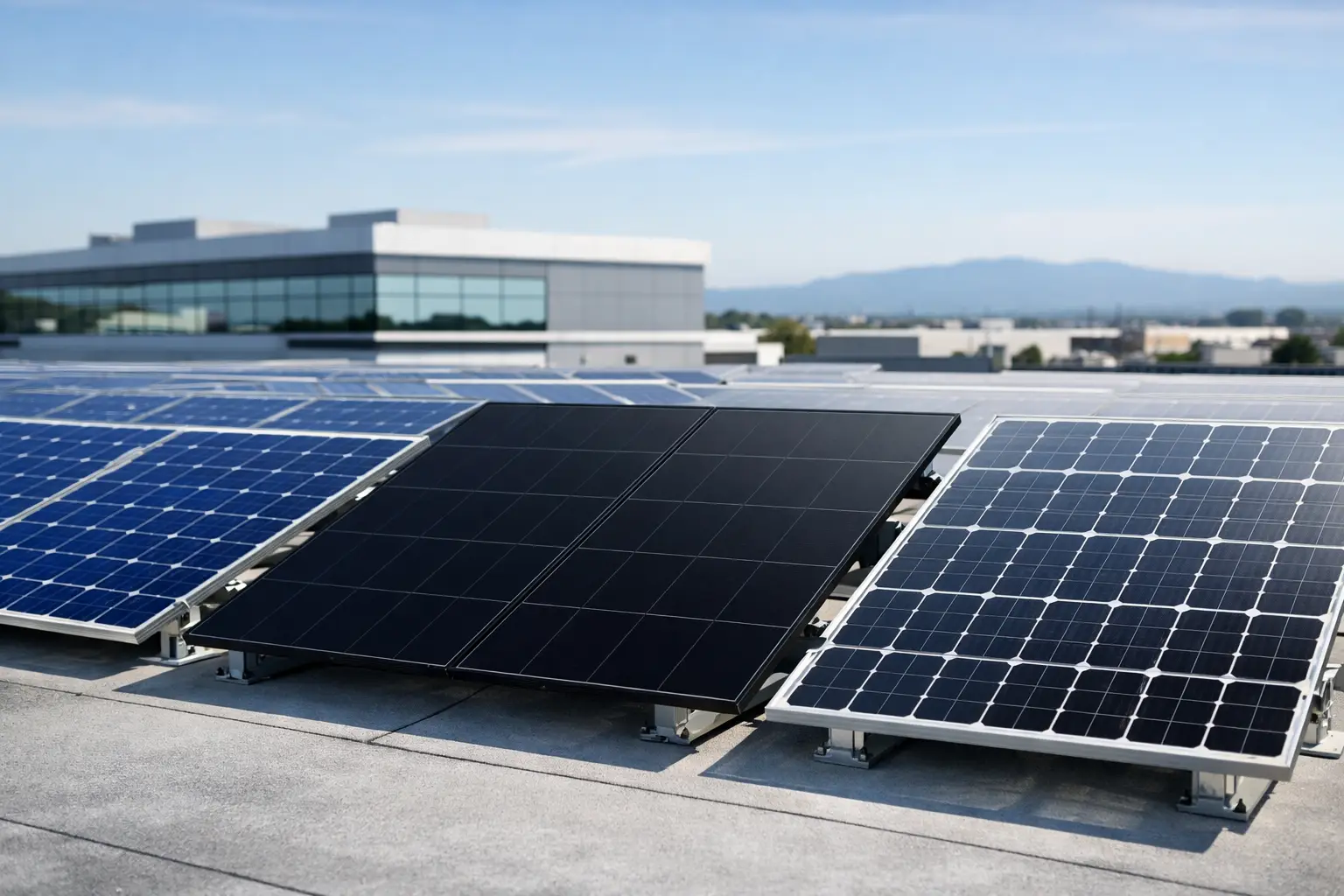
If you are comparing the different types of commercial solar panels for a warehouse, office, farm building or retail site, the right answer is rarely just “the most efficient one”. Roof space, budget, building use, shading, loading limits and long-term return all matter. A good solar design starts with the panel type, but it should never end there.
For most UK businesses, the real question is not simply which panel looks best on a spec sheet. It is which one will deliver reliable generation, sensible payback and the fewest headaches over the life of the system. That is where understanding the main panel types helps.
Types of commercial solar panels at a glance
In commercial projects, you will usually come across three main types of commercial solar panels: monocrystalline, polycrystalline and thin-film. There are also differences within those groups, such as half-cell modules, bifacial panels and all-black designs, but the core technology still sits within those broad categories.
Each type has its strengths. Monocrystalline panels are typically chosen where efficiency and space use are the priority. Polycrystalline panels have historically offered a lower upfront cost, although the gap is not what it once was. Thin-film panels suit some specialist applications, but they are less common on standard commercial rooftops in the UK.
Monocrystalline panels
Monocrystalline panels are now the most common choice for commercial solar installations, and with good reason. They are made from single-crystal silicon, which gives them a more uniform structure and generally higher efficiency than other mainstream options.
That higher efficiency matters when roof space is limited or when you want to maximise output from a given footprint. If you have an office block, industrial unit or school with a finite usable roof area, monocrystalline panels can generate more electricity per square metre. For many businesses, that improves the economics because every section of suitable roof is working harder.
They also tend to perform well in lower light conditions. In the North East, where bright sunshine is not exactly a daily guarantee, that can be a practical advantage. It does not mean they somehow ignore poor weather, but they are generally a dependable all-rounder for UK conditions.
The trade-off is cost. Monocrystalline panels usually come with a higher purchase price than older, lower-efficiency alternatives. That said, prices have moved considerably over the years, and many commercial clients now find the extra output justifies the difference. In practice, the cheapest panel is not always the cheapest system once generation and payback are taken into account.
Where monocrystalline panels make sense
They are often the best fit for businesses with constrained roof space, higher daytime electricity use and a focus on long-term performance. They also suit projects where appearance matters, such as visible office buildings or mixed-use developments, because they tend to have a cleaner, darker look.
Polycrystalline panels
Polycrystalline panels are made from multiple silicon fragments melted together. For years, they were seen as the budget-friendly option and were widely used where upfront cost mattered more than squeezing out the highest possible efficiency.
Their main limitation is that they are usually less efficient than monocrystalline panels. That means you need more roof area to generate the same amount of electricity. On a large agricultural building or expansive industrial roof, that may not be a problem. On a tighter commercial site, it often is.
They also tend to have a slightly bluer, less uniform appearance, which may matter on some developments and may not matter at all on others. A service yard roof hidden from public view is a different proposition from a customer-facing commercial premises.
The important point is that polycrystalline panels are not automatically poor value. If the roof is large, the loading is suitable and the pricing is right, they can still form part of a sensible commercial scheme. But because monocrystalline technology has become more competitive, polycrystalline is less dominant than it used to be.
Thin-film panels
Thin-film panels work differently from crystalline silicon panels. Instead of using thicker silicon wafers, they use thin layers of photovoltaic material applied to a surface. That makes them lighter and, in some cases, more flexible.
This can be useful on buildings where roof weight is a serious constraint or where the mounting approach needs to be adapted around an unusual structure. Some thin-film products also perform relatively well in diffuse light and high temperatures, though temperature is less of a commercial issue in the UK than in hotter climates.
The downside is efficiency. Thin-film panels usually need significantly more space to produce the same output as monocrystalline panels. For many UK commercial rooftops, that makes them less practical. If your aim is to offset a meaningful share of electricity demand on a standard roof, lower efficiency can quickly become the deciding factor.
Thin-film is therefore more of a specialist option than a mainstream one. It can be the right answer on the right building, but it is rarely the default choice for a commercial solar array.
Other panel features that matter
When people talk about the types of commercial solar panels, they often stop at mono, poly and thin-film. In reality, there are a few design features that can be just as important when comparing products.
Half-cell panels are now common in commercial systems. They split cells in two, which can improve performance and reduce energy losses. This is particularly useful on larger arrays where every bit of efficiency counts.
Bifacial panels generate power from both sides of the module. On ground-mounted systems or certain flat roof layouts with reflective surfaces, that can improve total yield. On a straightforward pitched commercial roof, the benefit may be limited, so this is very much a case of it depends.
There is also the question of panel durability and warranty. Commercial solar is a long-term investment, so the product itself needs to stand up to weather exposure, temperature changes and decades of service. A panel with a slightly lower headline efficiency but a stronger degradation warranty can be the better business decision.
How to choose the right panel for your building
The best panel is the one that fits the building, the consumption profile and the financial objective. That sounds obvious, but it is where many early-stage comparisons go off track.
Start with roof space. If your usable roof area is limited by plant equipment, skylights, access routes or shading, higher-efficiency monocrystalline panels often come to the front. If you have a large open roof and a tighter capital budget, a broader range of products may be suitable.
Then look at electricity demand. Commercial solar works best when the building can use a good share of the generated power on site, especially during working hours. A factory, office or retail unit with strong daytime demand can usually justify a more output-focused design than a site that sits quiet for much of the day.
Roof structure matters too. Panel choice is not separate from mounting design, ballast requirements or structural loading checks. A lighter panel or different layout may be needed if the roof has constraints. This is one reason a proper survey matters far more than an online price comparison.
Finally, think beyond panel cost. Installation complexity, inverter selection, maintenance access, expected generation and system lifespan all affect value. Commercial clients are usually better served by looking at cost per kilowatt-hour generated over time, not just the price per panel on day one.
What most UK businesses end up choosing
For the majority of commercial installations in the UK, monocrystalline panels are now the front-runner. They offer a strong mix of efficiency, reliability and sensible use of available roof space. That is especially relevant for businesses trying to reduce grid reliance without covering every square metre of roof.
Polycrystalline still has a place in some projects, particularly where roof area is generous and the numbers stack up. Thin-film remains more niche and tends to be selected only when a specific building condition points in that direction.
In other words, there is no single panel type that wins every time. The right answer comes from matching technology to the building rather than forcing the building to fit the technology.
At SWH Electrical Solutions, that is usually where the most successful commercial projects begin – not with sales jargon, but with a proper look at the roof, the load profile and what the client actually wants the system to achieve. If you are weighing up panel options, the smartest next step is to treat the panel as one part of the decision, not the whole of it. The right system should work hard for your business for years, quietly getting on with the job.