If your panels are looking a bit grubby after a spell of dry weather, tree pollen, or a visit from the local gulls, it is fair to wonder how to clean domestic solar panels without doing more harm than good. Most homeowners are not dealing with a delicate science experiment, but solar panels do need the right approach. A quick scrub with the wrong kit, or a risky trip onto the roof, can cost far more than a bit of lost generation.
For most homes in the North East, rain does a decent amount of the routine cleaning. Panels are designed to sit outside year-round, and a normal layer of dust usually has only a modest effect on output. The problem starts when dirt builds up unevenly or sticks around – bird droppings, traffic film, moss, leaves, and hard water marks are the usual culprits. That is when cleaning becomes less about appearance and more about protecting performance.
Do domestic solar panels actually need cleaning?
Sometimes yes, sometimes no. That is the honest answer.
If your system is pitched at a reasonable angle and free from nearby trees, regular rainfall often keeps it serviceable. A light film of dust is not usually worth climbing a ladder for. On the other hand, if panels are shaded by trees, close to busy roads, or frequently hit by birds, the build-up can be enough to reduce efficiency in a noticeable way.
A sudden drop in generation is not always a cleaning issue either. It could be seasonal variation, shading changes, inverter issues, or a fault elsewhere in the system. Before assuming grime is the problem, check your monitoring app if you have one. If output has dipped more than expected for the time of year and the panels are visibly dirty, cleaning may help. If output has dropped sharply with no obvious surface dirt, it is worth having the system checked properly.
How to clean domestic solar panels without damaging them
The safest method is also the simplest. Use clean water, soft equipment, and a cautious bit of patience.
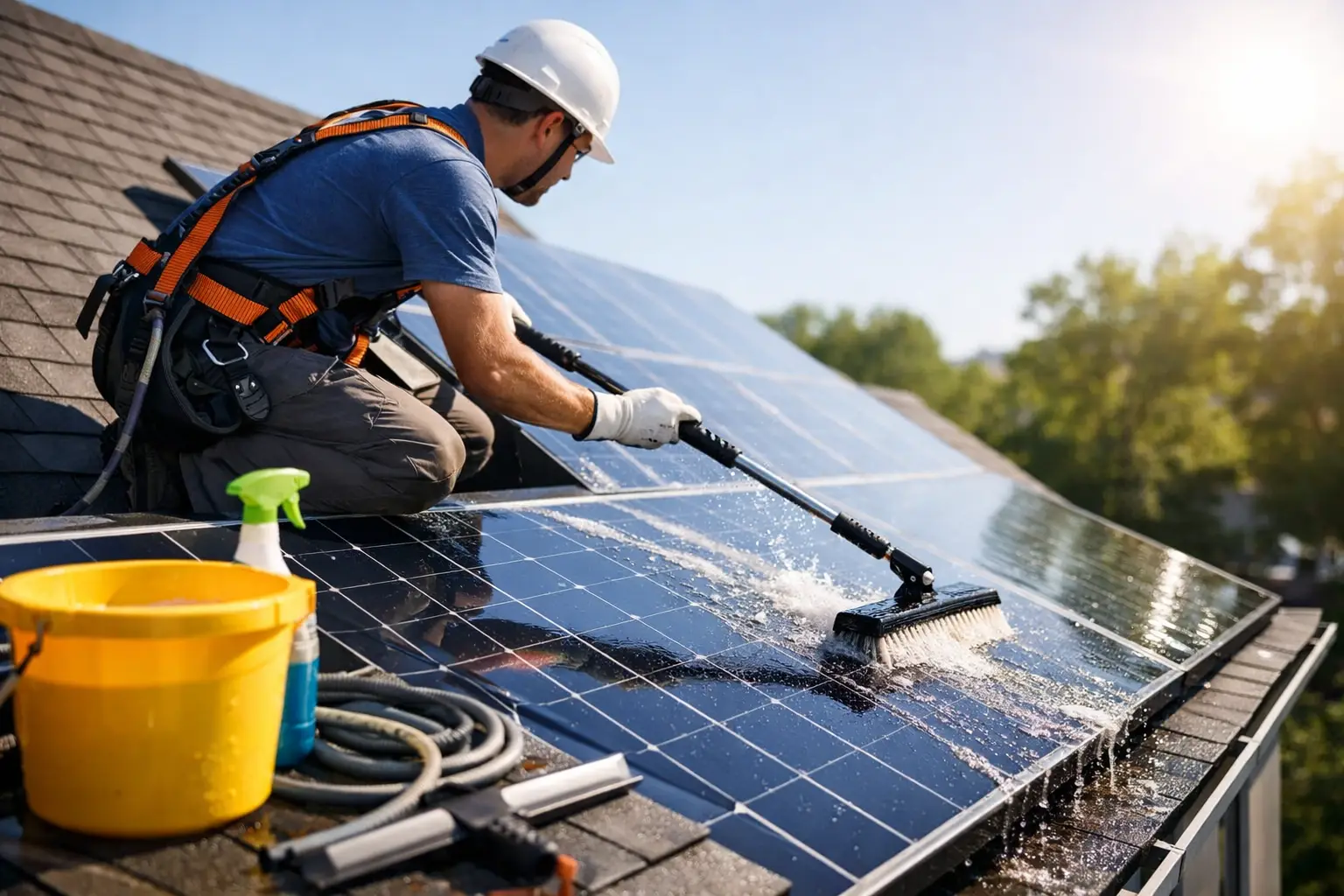
If the panels are accessible from ground level or from a safe working position, start by rinsing them with plain water. This helps loosen dust and grit so you are not dragging abrasive particles across the glass. After that, use a soft brush, sponge, or non-abrasive cloth on an extendable pole to gently remove stubborn marks. Then rinse again and allow the panels to air dry.
What matters just as much is what not to use. Avoid pressure washers, harsh detergents, abrasive pads, metal scrapers, and anything that could scratch the glass or force water into seals and electrical components. Domestic solar panels are tough, but they are not built for aggressive cleaning methods. If you would not use it on a car windscreen, it probably does not belong on a panel either.
Cleaning early in the morning or later in the evening is usually best. Panels can get surprisingly hot in direct sun, and adding cold water to hot glass is not a great idea. You also get less streaking when the surface is cooler.
Safety comes first – especially on roofs
This is the point where common sense needs to overrule enthusiasm.
If your panels are on a typical pitched roof, cleaning them yourself may not be worth the risk. Working at height is the biggest hazard by far, not the cleaning itself. Wet roofs, awkward access, and overconfidence make a poor combination. A small gain in generation is not worth a trip to A&E.
If there is any doubt about safe access, leave it alone and bring in a professional. That is particularly true for older roofs, tall properties, extensions with fragile coverings, or any setup where you would need to lean awkwardly over the roofline. A reputable solar maintenance provider will have the right access equipment and know how to clean panels without causing damage.
There is also the electrical side to think about. You should never open components, interfere with wiring, or spray water near connectors and isolators. Cleaning the glass surface is one thing. Tampering with the system is another.
When cleaning helps and when it probably will not
Homeowners often expect a dramatic improvement after a clean, but the result depends on what was actually sitting on the panels.
If the issue is a thick layer of bird mess, heavy pollen, or grime from nearby traffic, cleaning can make a worthwhile difference. If the panels just have a normal film of dust, the gain may be small. In some cases, the money spent on professional cleaning will not be fully recovered through extra generation alone. That does not make cleaning pointless, but it does mean it should be done for the right reasons.
A good rule of thumb is this: clean when there is visible build-up, when monitoring suggests underperformance, or as part of broader maintenance. Do not clean simply because someone told you solar panels should sparkle like a showroom window.
How often should you clean solar panels?
There is no one-size-fits-all timetable, because location and roof conditions matter.
For many domestic systems, an inspection once or twice a year is enough. If the panels look clear and generation is in line with expectations, you may not need to do anything. Homes near trees, farms, coastal areas, or busy roads may need more frequent attention. The same goes for properties that regularly attract nesting birds.
Autumn and spring are sensible times to check. Autumn can leave behind leaves, sap, and debris, while spring often brings pollen and a clearer view of how the system is performing after winter. If your property has a history of heavy bird fouling, you may need to monitor more often.
Signs it is time for a professional clean or inspection
Sometimes the dirt is only part of the story.
If you can see staining that will not shift with light cleaning, moss around the panel edges, pooled debris, or persistent drops in output, a professional visit is sensible. The same applies if panels are difficult to access safely or if you are not sure whether the issue is dirt, shading, or a technical fault.
A proper maintenance visit can do more than clean. It can identify loose fittings, cable issues, signs of water ingress, inverter warnings, or bird-related damage around the array. That broader check is often where the real value lies, especially on systems that have been in place for a few years.
For homeowners who want the job handled properly without guesswork, companies such as SWH Electrical Solutions can assess whether the panels need cleaning at all, or whether the better answer is a maintenance inspection.
Common mistakes to avoid
The biggest mistake is assuming more force means a better clean. It does not. Pressure washing can damage seals, frames, and fixings. Strong chemical cleaners can leave residues or react badly with materials. Walking directly on panels is another definite no.
Another common error is cleaning at the hottest part of the day. Apart from the risk of thermal shock, water dries too quickly and leaves marks behind. Using hard water can also cause mineral deposits, especially if the panels are already warm.
Then there is the temptation to ignore nearby causes of repeat build-up. If overhanging branches are dropping sap and leaves onto the array, or birds are nesting under the panels, cleaning alone will not solve the problem for long. In those cases, it is worth dealing with the source as well.
A sensible approach for most homeowners
If your panels are easy to reach safely, visibly dirty, and you can clean them gently with plain water and soft tools, there is nothing wrong with doing so carefully. If access is awkward, the dirt is stubborn, or performance has dropped for no obvious reason, professional help is the better option.
Solar is meant to make life easier and energy bills lower, not create another risky weekend job. A bit of practical judgement goes a long way here. Keep an eye on performance, check the panels now and then, and if they need attention, treat them with a light touch. Your system will usually tell you when it needs more than a rinse.