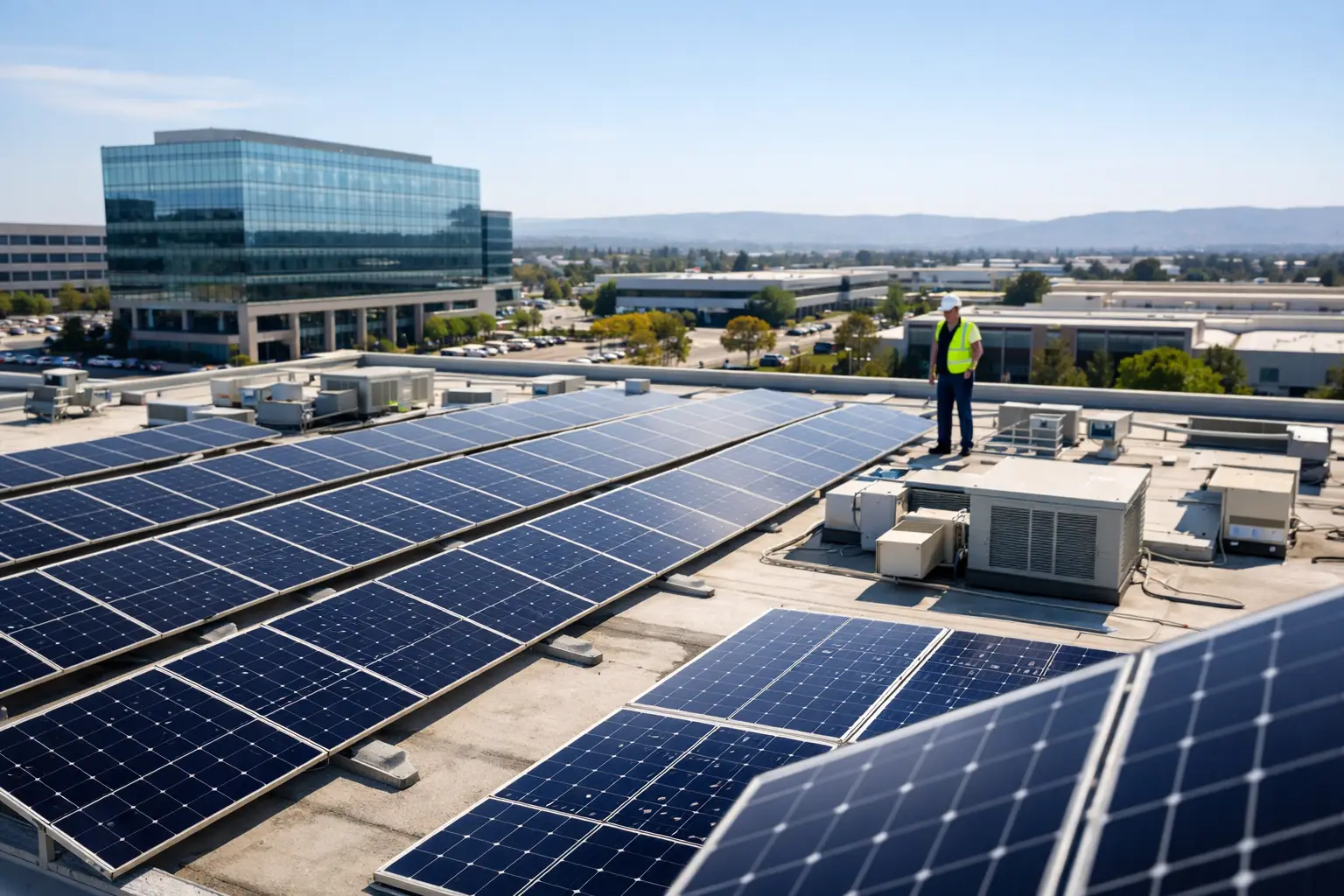
If your business uses most of its electricity during the day, commercial solar can make a lot more sense than many people realise. That is usually the point where the question shifts from general interest to something more practical – how does commercial solar work, and what would it actually do for a real site, real bills, and real operations?
At its simplest, a commercial solar system turns daylight into usable electricity for your building. Panels on the roof or ground generate direct current, an inverter converts it into alternating current, and your premises use that power in real time. If the system produces more than you need at that moment, the surplus can sometimes be exported to the grid or stored in batteries, depending on how the site is designed.
That is the short version. The useful version is understanding what sits behind it, how the pieces work together, and why some systems deliver stronger savings than others.
How does commercial solar work in practice?
A commercial solar PV system is designed around your building’s energy demand, roof space, operating hours, and electrical setup. Unlike a small domestic system, commercial solar often has to account for larger three-phase supplies, more complex switchgear, multiple distribution boards, and equipment with predictable daytime loads such as lighting, refrigeration, machinery, office systems, or EV charging.
When sunlight hits the photovoltaic cells in the panels, they generate electricity. This power starts as DC electricity, which is not usually what your building systems run on. The inverter changes it into AC electricity so it can feed directly into your site’s electrical system.
From there, the electricity is used by your business first. That matters because the biggest financial benefit normally comes from using your own solar generation on site, reducing the amount of electricity you need to buy from your supplier. Imported grid power tends to cost more than the value paid for exported power, so self-consumption is where commercial solar often proves its worth.
If your business is quiet at weekends but busy Monday to Friday, or if you have a steady daytime load across the week, the system can be sized to match that pattern. Getting that balance right is one of the main differences between a system that looks good on paper and one that performs well over time.
The main parts of a commercial solar system
The panels are the most visible part, but they are only one piece of the job. The system also includes mounting equipment, inverters, isolators, cabling, generation meters, and monitoring hardware. In some cases, it will include battery storage or export limitation controls as well.
Panels generate the electricity, but the inverter is doing a lot of the heavy lifting behind the scenes. It converts power into a form the building can use and also helps optimise performance, safety, and monitoring. Depending on the size and layout of the installation, a site might use one central inverter or multiple string inverters.
Mounting systems matter more than many businesses expect. A flat commercial roof, a pitched roof, and a ground-mounted array all need different fixing methods and load calculations. Roof condition, wind uplift, shading, and access for maintenance all need proper consideration before any installation goes ahead.
Then there is the connection into the building’s electrical infrastructure. On a commercial site, that part has to be handled carefully. The solar system must integrate safely with the existing supply, distribution boards, and any other major plant already in place. This is where experienced electrical design makes a real difference.
What happens to the power your panels generate?
The electricity generated by the panels is not stored automatically. First, it is used by whatever equipment is running in the building at that time. If your office lights, computers, air conditioning, refrigeration units, or workshop equipment are drawing power, the solar generation helps supply them.
If generation is lower than demand, the building simply tops up from the grid as normal. There is no interruption. If generation is higher than demand, the excess can either be exported or diverted into battery storage if batteries are part of the system.
This is why usage profile matters so much. A warehouse operating through daylight hours will often benefit differently from a hospitality venue with more evening demand. The technology works in both cases, but the financial outcome depends on when you use electricity, not just how much you use overall.
How batteries fit into commercial solar
Battery storage is not essential for every commercial solar installation, but it can be useful in the right setup. Batteries store excess electricity generated during the day so it can be used later, such as during early morning starts, evening operations, or peak tariff periods.
For some businesses, batteries improve self-consumption and reduce reliance on imported power. For others, the extra capital cost can lengthen payback beyond what makes commercial sense. It depends on tariff structure, operating hours, available space, and how often the site produces spare generation worth storing.
If a business has time-of-use tariffs, overnight processes, or resilience concerns, batteries become more interesting. If the site already uses most of its daytime generation directly, batteries may be less of a priority at the start.
Is every commercial building suitable?
Not every site is equally well suited, and a good installer should be honest about that. The best candidates usually have a decent amount of unshaded roof space, strong daytime electricity use, and a roof structure in suitable condition.
Shading from nearby buildings, plant equipment, or trees can reduce performance. Roof orientation matters too, though it is not as simple as saying only south-facing roofs work. East-west layouts can still perform very well on commercial properties, especially where they better match demand across the day.
Roof condition is another practical point. If a roof is due for major works in the near future, it may be sensible to deal with that first rather than install panels and disturb them later. Structural assessment is also important, particularly on older buildings or large flat roofs.
Grid connection can be another factor. Some sites can export freely, while others may face limits set by the network operator. That does not always stop a project, but it can influence system size and design.
How savings are actually made
Most businesses look at commercial solar for one reason first: lowering running costs. The main saving comes from buying less electricity from the grid. Every unit of solar power you use on site is a unit you have not had to import at standard commercial rates.
There can also be value in exported electricity, depending on your tariff and setup, but export payments alone rarely make the project stack up. The strongest returns usually come from offsetting your own daytime consumption.
There is also a longer-term benefit in reducing exposure to energy price volatility. No solar system removes your grid connection entirely in a standard commercial setup, but it can reduce how much of your operating cost is tied to external electricity prices.
Payback periods vary. System size, installation cost, roof complexity, energy use pattern, and tariff rates all affect the numbers. A business with consistent daytime demand will usually see a better return than one with low occupancy during solar generation hours.
Maintenance and ongoing performance
Commercial solar is generally low maintenance, but it is not a fit-and-forget asset. Systems should be monitored, inspected, and maintained properly to protect performance and safety.
Panels have no moving parts, which helps, but inverters, isolators, fixings, and electrical connections still need attention over time. Monitoring software can flag faults or underperformance early, which is especially useful on larger systems where a problem may otherwise go unnoticed.
Cleaning is a case-by-case issue rather than an automatic requirement. Some roofs and locations stay relatively clear with normal rainfall, while others collect more dirt, bird fouling, or debris. A proper maintenance plan should be based on the environment and the system’s actual performance, not guesswork.
For businesses already managing compliance, planned maintenance, and electrical safety across a site, it makes sense to treat solar the same way – as part of the wider building services picture, not as a standalone add-on.
How does commercial solar work for different types of business?
For offices, the fit is often straightforward. Daytime occupancy, IT load, lighting, and HVAC demand tend to align well with solar generation. For industrial sites, the opportunity can be even stronger where machinery and plant create a steady daily base load.
Retail units, schools, farms, car dealerships, leisure facilities, and multi-unit commercial properties can all benefit too, but for slightly different reasons. Some want direct bill savings. Some want to support EV charging. Some are working towards sustainability targets or trying to improve the long-term value and efficiency of their premises.
For developers, commercial solar can also support planning requirements, building performance goals, and buyer expectations. When electrical design, energy systems, and compliance are considered together from the outset, the result is usually cleaner and more cost-effective than retrofitting later.
That joined-up approach is where a contractor with both solar and wider electrical expertise tends to add real value. SWH Electrical Solutions works across commercial solar, electrical installations, compliance, and related building services, which matters when a project needs more than panel fitting alone.
Commercial solar is not magic, and it is not identical from one site to the next. But when the design matches the building, the usage profile, and the electrical setup, it becomes a practical tool for cutting costs and future-proofing a property. The best place to start is not with a guessed system size, but with a proper look at how your building actually uses power day to day.