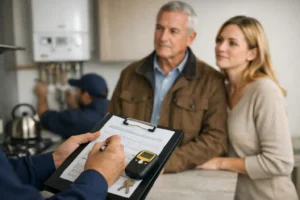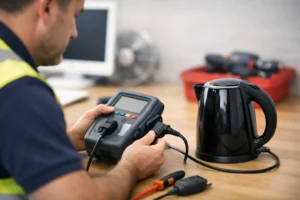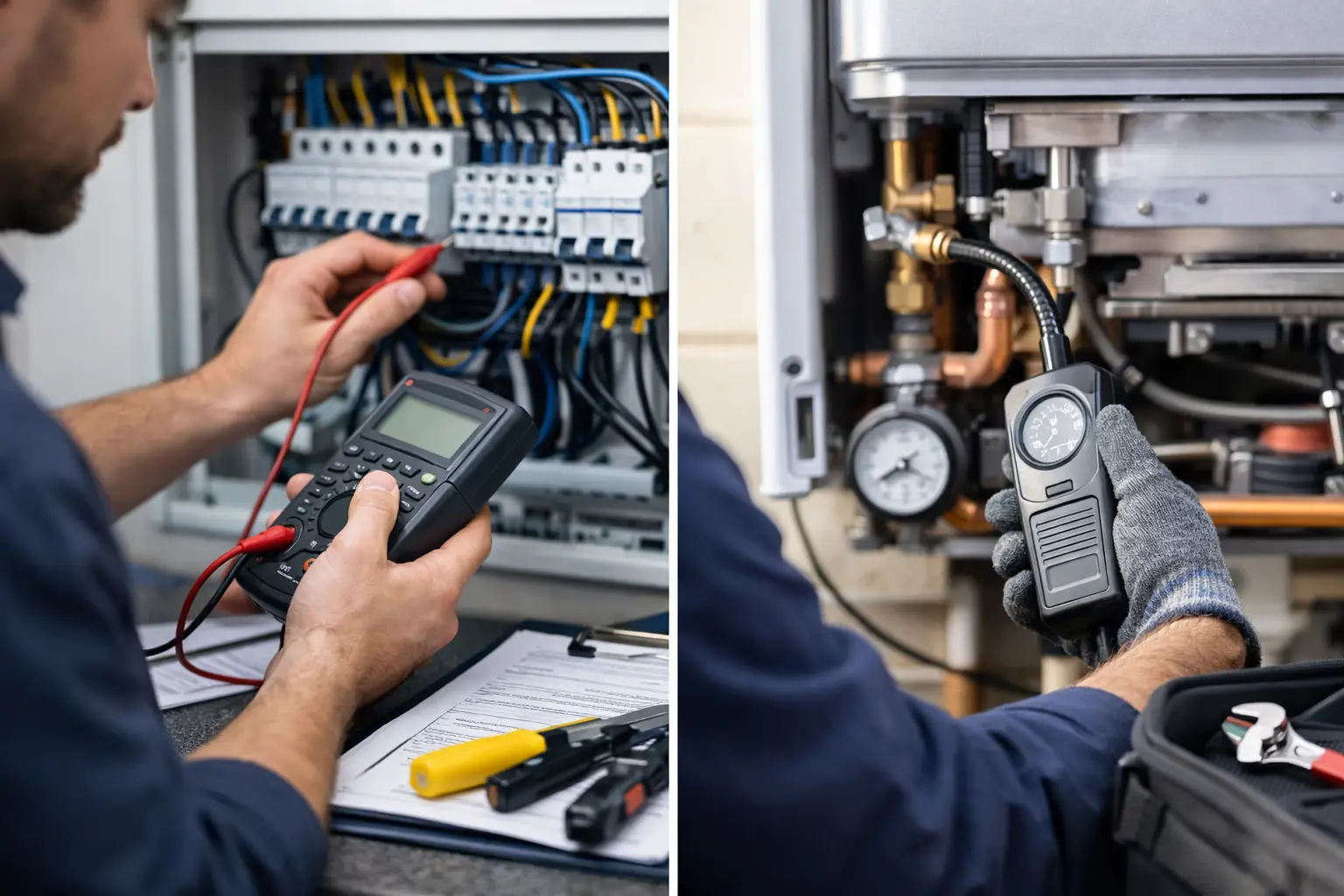
A boiler can be working perfectly while an overloaded consumer unit is creating a serious fire risk. Equally, a sound electrical installation says nothing about whether a gas appliance is burning safely. That is the practical difference in the EICR vs landlord gas certificate question: rental properties need separate checks because they deal with two completely different hazards.
For landlords, agents and developers handing over new homes, treating one as a substitute for the other is a costly mistake. Both form part of responsible property management, but they have different legal requirements, inspection methods, renewal periods and competent-person rules.
EICR vs landlord gas certificate: the key difference
An Electrical Installation Condition Report, usually called an EICR, assesses the fixed electrical installation in a property. This includes the consumer unit, wiring, sockets, switches, lighting circuits, earthing and bonding. Its purpose is to identify deterioration, damage, defects or non-compliance that could lead to electric shock or fire.
A landlord gas safety certificate is commonly known as a CP12 or Gas Safety Record. It confirms that the gas appliances and associated flues checked during the visit meet the required safety standards at that time. It typically covers items such as boilers, gas fires and cookers where these are supplied by the landlord.
Put simply, an EICR examines the property’s fixed electrics. A CP12 examines gas appliances, their combustion performance and their safe operation. One cannot cover the other, even where the work is arranged on the same day.
What an EICR checks in a rental property
An EICR is not a quick visual check or a test of whether a plug socket powers a phone charger. A qualified electrical inspector carries out a structured inspection and testing process on the fixed installation. Depending on the size and condition of the property, this may include testing circuit protection, insulation resistance, polarity, earthing arrangements and the operation of RCD protection.
The report identifies observations using standard classification codes. C1 means danger is present and urgent action is required. C2 means a potentially dangerous condition needs remedial work. FI means further investigation is required without delay. Any C1, C2 or FI observation produces an unsatisfactory report until the issue has been properly investigated or rectified. A C3 observation is a recommendation for improvement and does not, on its own, make the report unsatisfactory.
For private rented homes in England, landlords must ensure the electrical installation is inspected and tested at least every five years, or sooner if the report recommends a shorter interval. A copy of the report must be provided to existing tenants within 28 days, to new tenants before they move in, and to the local authority within seven days if requested. Requirements elsewhere in Great Britain can differ, so landlords with properties across more than one nation should check the rules that apply locally.
An EICR should be completed by an electrician who is competent to inspect and test the installation. This is specialist work, not simply general electrical maintenance. Using a contractor with appropriate competence and recognised accreditation gives landlords clearer evidence that the inspection has been carried out properly.
What a landlord gas safety certificate checks
A Gas Safety Record must be completed every 12 months for relevant gas appliances and flues in a rented property. The inspection is carried out by a Gas Safe registered engineer who is qualified for the type of appliance being checked.
During the visit, the engineer will inspect the appliance’s safe operation, ventilation where relevant, flue condition and performance, and whether combustion products are being safely removed. They will also check for signs of unsafe operation, including gas leaks or inadequate combustion. The exact checks depend on the appliances installed and their location.
Landlords must provide tenants with a copy of the current Gas Safety Record within 28 days of the check. New tenants must receive a copy before moving in. Records should be retained for at least two years. These duties apply to gas appliances provided for the tenant’s use, including appliances in communal areas that serve the rented accommodation.
A CP12 does not prove that a boiler will never develop a fault during the year. It is a record of its condition at the point of inspection. Annual boiler servicing is still sensible, particularly where it is combined with the gas safety check, because servicing helps maintain performance and can spot developing issues before they become a breakdown.
Different timescales, different specialists
The most obvious difference between an EICR and a landlord gas certificate is the renewal cycle. Gas safety checks are annual. Electrical condition reports in English private rentals are generally required at least every five years, unless the EICR specifies an earlier inspection date.
That difference does not mean electrics need less attention between inspections. Tenants should be encouraged to report damaged sockets, tripping circuits, burning smells, flickering lights or visible cable damage straight away. Landlords should also act promptly where an electrician identifies remedial work after an unsatisfactory EICR.
The people who carry out the work are different too. Electrical inspection and testing must be undertaken by a competent electrician. Gas safety checks must be completed by a Gas Safe registered engineer with the right appliance categories on their registration. A business may offer both services, but the individual carrying out each inspection must hold the appropriate competence.
What happens if the report is unsatisfactory?
An unsatisfactory EICR is not something to file away until the next tenancy. In England, landlords must ensure remedial work or further investigation is completed within 28 days, or within the shorter period stated in the report. Written confirmation that the work has been completed must then be supplied to the tenant and, if requested, the local authority.
With gas safety, an engineer may identify an appliance as unsafe and take action to prevent its use. This could mean switching it off, disconnecting it or advising that it must not be used until repairs are complete. The landlord should arrange remedial work without delay. Trying to keep a tenant warm with an unsafe boiler is not an option – safety comes first.
In both cases, prompt action protects people and reduces the risk of a small defect escalating into a major repair, insurance issue or enforcement matter.
Can landlords arrange both checks together?
Yes, and for many landlords it is the most practical approach. Booking electrical and gas compliance visits together can reduce disruption for tenants, simplify access arrangements and make the property’s compliance diary easier to manage. It is particularly useful before a new tenancy begins, after major refurbishment, or when a developer is preparing homes for handover.
There is one caveat: do not let convenience dictate the inspection date if either certificate is due sooner. The annual gas check and the EICR due date should be tracked separately. A simple property schedule recording the expiry date, any remedial work and copies issued to tenants can prevent avoidable gaps.
For properties with solar PV, battery storage, EV charge points or significant electrical alterations, it is also worth keeping installation certificates and commissioning records alongside the EICR. These documents give the inspecting electrician a clearer picture of the installation and help ensure later work is assessed correctly.
A practical approach for landlords and developers
The best time to think about compliance is before a tenant reports a problem or a move-in date is looming. Keep accurate records, give contractors clear access to meters, consumer units and appliances, and make sure tenants know when an inspection is booked. If a report identifies work, arrange it quickly and retain the evidence of completion.
SWH Electrical Solutions can coordinate EICRs alongside CP12 landlord gas safety certificates through its qualified electrical and Gas Safe registered teams, helping North East landlords keep essential checks straightforward. A well-maintained home is easier to let, easier to manage and, most importantly, a safer place for someone to live.