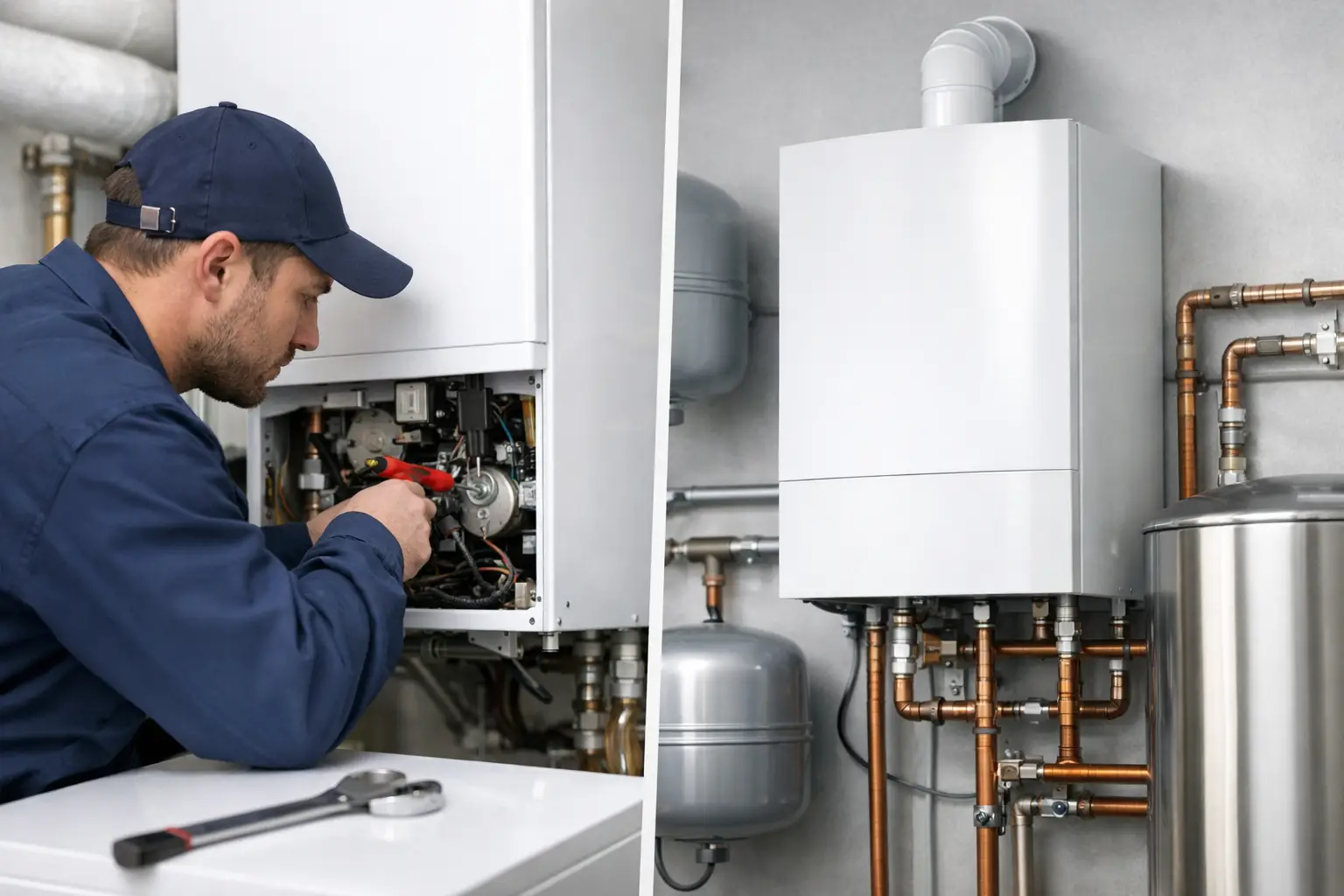
A boiler rarely chooses a convenient moment to fail. One day the heating takes longer to respond, the next you are facing a cold shower or an unfamiliar fault code. When weighing up boiler repair or replacement, the right answer is not always the cheapest option on the day. It is the option that gives you safe, dependable heating without repeatedly draining your budget.
For homeowners across Newcastle and the North East, the decision usually comes down to the boiler’s age, the fault itself, its efficiency and the likely cost of keeping it running. A qualified Gas Safe registered engineer can assess all four properly, rather than offering a guess over the phone.
Boiler repair or replacement: start with the fault
Some boiler problems are frustrating but straightforward to fix. A failed thermostat, worn fan, faulty pressure sensor or leaking valve may be repaired economically, particularly where the boiler is relatively modern and has been serviced regularly. If the repair restores reliable operation and the part is readily available, repairing can be the sensible route.
The picture changes when faults become recurring. Perhaps the boiler has needed call-outs in consecutive winters, pressure keeps dropping, hot water is inconsistent or the display repeatedly shows different error codes. One repair may still be affordable, but a pattern of repairs tells you the appliance is reaching the point where further spending becomes harder to justify.
An engineer should identify the cause of the failure, explain the available repair and outline what can reasonably be expected next. That clarity matters. Replacing a part without investigating why it failed can create a false economy.
Never ignore safety concerns
A boiler that has been identified as unsafe should not be treated as a budgeting exercise. If you smell gas, suspect a carbon monoxide issue, see scorch marks, or feel unwell with headaches, nausea or dizziness while the boiler is operating, switch the appliance off if it is safe to do so, ventilate the property and seek urgent professional advice.
Carbon monoxide has no smell or colour. Every home with gas appliances should have a working audible carbon monoxide alarm, installed and maintained in line with the manufacturer’s instructions. Annual servicing by a Gas Safe registered engineer also gives faults a better chance of being caught before they become an emergency.
When repairing a boiler makes good sense
Repair is often the best value where the boiler is under around 10 years old, has a clear and isolated fault, and has otherwise been reliable. Modern condensing boilers can have a useful working life of 10 to 15 years or more when correctly installed, regularly serviced and used with a clean, well-balanced heating system.
It is also worth considering whether the boiler remains suitable for the home. If it provides enough hot water, heats rooms evenly and is not costing a disproportionate amount to run, a repair may preserve a perfectly capable system. There is little benefit in replacing a boiler simply because a small component has failed.
The key is to compare the repair cost with the boiler’s remaining likely lifespan. A modest repair on an eight-year-old appliance can be sensible. The same repair on a 16-year-old boiler with obsolete parts and several recent call-outs may only delay a bigger decision by a few months.
Signs that boiler replacement is the better investment
Age alone does not condemn a boiler, but it is a useful guide. Older non-condensing models are generally less efficient than modern condensing boilers, meaning more of the fuel you pay for is lost through the flue. Replacing an inefficient system can reduce gas use, although the actual saving depends on the property, insulation levels, heating controls and household habits.
Replacement deserves serious consideration when repair costs are high relative to a new installation, parts are difficult to source, or the boiler repeatedly breaks down. It may also be the practical choice if the current boiler is undersized, oversized or poorly located. A growing family, a loft conversion, an additional bathroom or an extension can all expose the limits of an older system.
Look beyond the boiler casing, too. The condition of radiators, pipework, controls and the hot water arrangement affects comfort and performance. Installing a new boiler onto a system full of sludge can reduce its efficiency and put components under unnecessary strain. A proper survey should establish whether system cleaning, filter installation, new controls or radiator upgrades are required as part of the job.
Better controls can make a real difference
A new boiler is an opportunity to improve how heating is controlled. Programmable controls, room thermostats and thermostatic radiator valves can help avoid heating empty rooms or running the system hotter than necessary. Weather compensation and smart controls may suit some homes, but only when they are configured around how the household actually lives.
The best setup is not necessarily the one with the most features. It is one that is easy to understand, correctly commissioned and used consistently. A good engineer will explain the controls before leaving, rather than handing over a manual and hoping for the best.
Compare the whole cost, not just the call-out fee
The lowest immediate price is not always the lowest cost over the next five years. When deciding between boiler repair or replacement, ask for a clear breakdown of the repair, including labour, parts and any diagnostic work. Then compare it with the likely scope of a replacement installation: the boiler, flue work, controls, magnetic filter, system treatment, commissioning and warranty.
A replacement costs more upfront, but it can offer predictable performance, a manufacturer warranty and lower running costs where an old boiler has become inefficient. A repair costs less now and may be entirely justified, but it does not reset the age of the existing appliance or remove the risk of another component failing.
Avoid choosing solely on a headline boiler price. The quality of installation is central to the boiler’s future reliability. Correct sizing, suitable pipework, proper system cleansing and thorough commissioning matter as much as the badge on the front. An incorrectly specified boiler can short-cycle, waste energy and wear prematurely, whatever its stated efficiency rating.
Questions worth asking before you decide
Before approving work, ask the engineer how old the boiler is, what has failed, whether the replacement part is readily available and whether there are signs of wider system problems. Ask how long the repair is likely to last, not as a promise but as a realistic professional judgement.
If replacement is recommended, ask why the proposed boiler size and type suit your property. A combi boiler can be an excellent option for many homes with modest hot water demand and no need for a cylinder. Homes with several bathrooms or higher simultaneous hot water use may be better served by a system or regular boiler with a cylinder. The answer depends on usage, water pressure, space and future plans.
For landlords, there is an added duty of care. A CP12 landlord gas safety certificate is required annually for relevant rented properties, but a certificate does not replace responsive maintenance when tenants report concerns. Reliable heating and hot water are fundamental to a safe, well-managed home.
Plan replacement before winter if you can
Breakdowns often happen when boilers are working hardest, which is why winter replacements can feel rushed. If your boiler is ageing but still operating, arranging a survey before the cold weather arrives gives you more time to consider the right solution, schedule work around your household and avoid making a major purchase under pressure.
That does not mean replacing every older boiler pre-emptively. A well-maintained appliance with no warning signs may continue to provide good service. It simply means paying attention to repair history, efficiency and reliability before the next cold snap makes the decision for you.
At SWH Electrical Solutions, our Gas Safe registered heating engineers assess the full system and explain the options in plain English. Whether a targeted repair keeps a good boiler going or a replacement gives you greater peace of mind, the aim is straightforward: safe heat, reliable hot water and a solution that makes financial sense for your home.