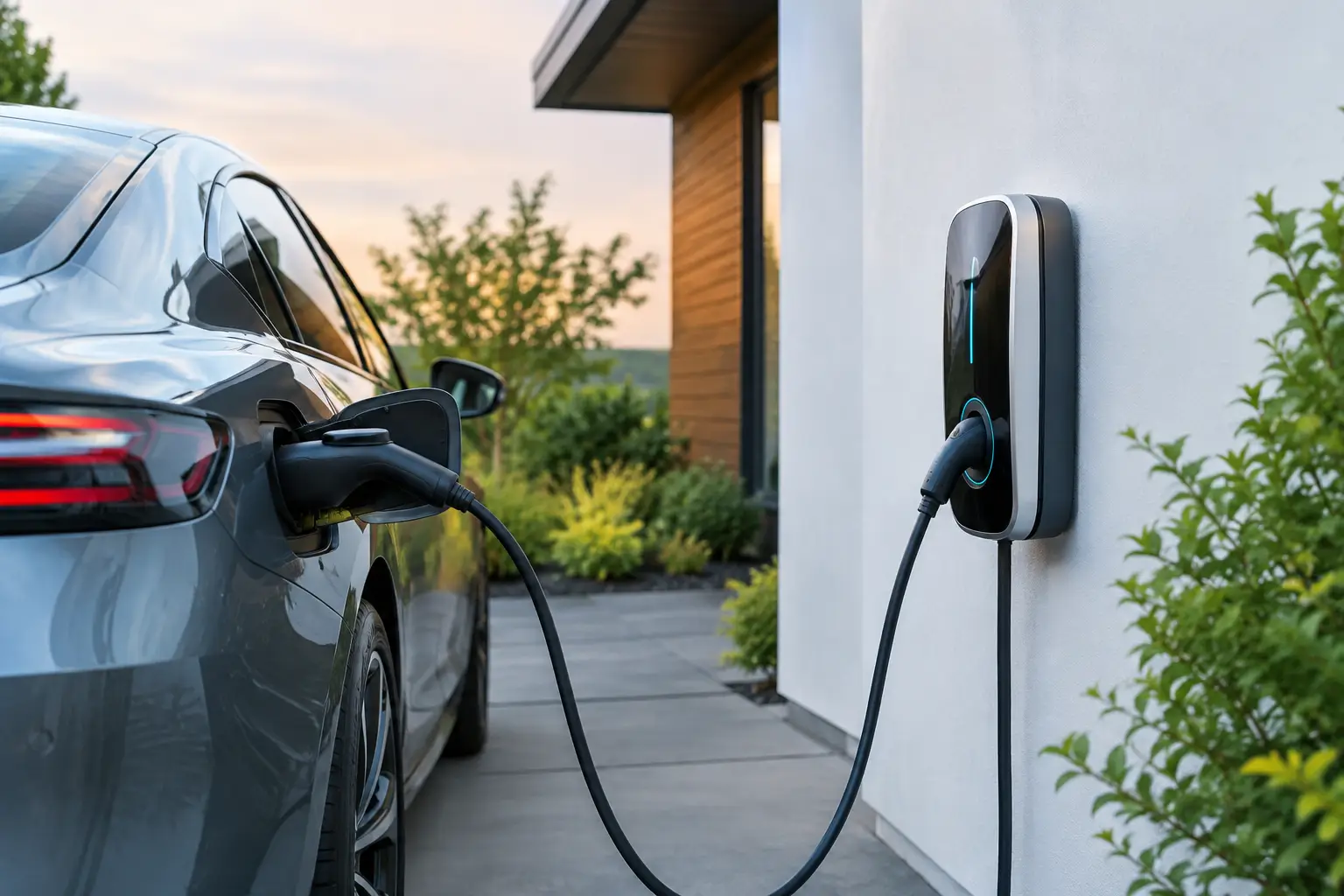
A new EV charger can look straightforward on paper: a charge point on the wall, a cable to the car and cheaper miles ahead. The detail that often decides whether charging is practical, however, is EV load balancing. It helps your charger work around the electricity already being used in the property, rather than asking your supply to deliver more than it safely can.
For homes across the North East, this can make the difference between an expensive supply upgrade and a well-designed installation that fits the way the household actually uses energy. It is equally useful for workplaces and new-build schemes where several charge points may need to share a limited electrical capacity.
What is EV load balancing?
EV load balancing is a control system that monitors a property’s electricity demand and adjusts the charging rate accordingly. It protects the incoming supply from being overloaded when high-demand appliances are running.
Think of a typical winter evening. The oven is on, the kettle has just boiled, the washing machine is running and an electric shower may be in use. If an EV charger were to draw its full rated output at the same time, the combined demand could exceed the capacity of the main fuse or distribution board.
A load-balancing device measures the current flowing through the incoming supply. When the building has spare capacity, it allows the vehicle to charge at a higher rate. When demand rises, it temporarily reduces the charge rate. Once that demand drops, the charger can increase again.
The car still charges, but it does so intelligently and within the limits of the installation. For most drivers charging overnight, a short reduction in speed is unlikely to make any noticeable difference by morning.
Why load balancing matters for UK properties
Many UK homes have a single-phase electrical supply, commonly protected by a 60A, 80A or 100A service fuse. A 7kW home charge point can draw around 32A by itself. That is a significant addition to a household already using electric cooking, showers, heat pumps, immersion heaters or other high-load equipment.
Without proper assessment and control, an EV charger could create unnecessary strain on the supply. In the best case, this may cause a protective device to operate. In the worst case, it can introduce safety concerns and leave the homeowner facing delays or additional work before charging can be used properly.
Load balancing is not a substitute for a competent electrical survey. The condition of the consumer unit, earthing arrangement, cable route, existing circuits and available supply capacity all need checking. But where the supply is suitable, dynamic load management is often a practical answer to competing electrical demands.
It can also help avoid the cost and uncertainty of applying for a supply upgrade from the network operator. An upgrade is sometimes necessary, particularly in larger homes with extensive electrification, but it should be based on real demand and sound design rather than assumption.
How EV load balancing works in practice
A compatible sensor, often called a current clamp or CT clamp, is fitted around the incoming supply cable. It continuously sends usage information to the charge point or its associated controller.
The installer sets a maximum limit based on the property’s supply and design calculations. If the household is using 45A and the agreed limit is 80A, the charger has room to use the remaining capacity. If demand then increases to 70A because the shower or hob is switched on, the charger will reduce its draw to keep the total below the limit.
This happens automatically. There is no need to go to the charger, rearrange household routines or guess whether it is safe to plug the car in. The precise response depends on the make and model of charge point, but the principle remains the same: the charger is the flexible load, not the rest of the property.
Some systems can also manage multiple chargers. At a workplace, for example, six cars may arrive in the morning but the site may not have enough spare capacity for every unit to operate at full power. The system shares the available load between vehicles, then reallocates capacity as cars finish charging or site demand changes.
Dynamic load balancing versus scheduled charging
Scheduled charging and load balancing solve different problems. Scheduling tells a charger when to operate, often allowing drivers to make use of lower overnight tariffs. Load balancing controls how much power the charger uses at any given moment.
The strongest installations often use both. The vehicle is set to charge during lower-cost hours, while dynamic load balancing remains active to protect the supply if other electrical demand increases. If a tariff changes or the driver needs a quicker top-up, the safety control is still there.
Is it needed for every EV charger?
Not always. A property with a generous supply, modest existing demand and one charge point may not require active load balancing. Equally, some chargers include it as a standard feature or can be configured to work with an optional sensor.
It becomes particularly worth considering where a home has electric showers, induction cooking, electric heating, a heat pump, battery storage or a solar PV system. The same applies when the property is being extended, converted or upgraded and its overall electrical demand is growing.
For commercial clients, the question is usually less about one charger and more about future capacity. Installing two charge points today may be simple. Installing eight over the next few years, while keeping machinery, lighting, HVAC and IT systems running, needs a proper load assessment and a scalable plan.
Property developers should consider load management early, before walls are closed and final distribution equipment is selected. Allowing for EV charging infrastructure at design stage is usually more cost-effective than trying to add capacity after completion. It also gives future residents or occupiers a clearer route to charging without major disruption.
Solar, batteries and smart charging
EV load balancing works especially well as part of a wider energy plan. If a home has solar panels, smart charging can be configured to use surplus generation where compatible equipment is installed. A battery may also support the property at certain times, depending on the system design and settings.
There is a trade-off. Charging only from surplus solar can be slower and less predictable, particularly during a grey North East winter. Charging on a low overnight tariff may be cheaper and more reliable, even if solar generation is available during the day. The right approach depends on driving mileage, work patterns, tariff rates, battery capacity and how much control the homeowner wants.
The key is to avoid treating each technology as a separate purchase. Solar, battery storage, electric heating and EV charging all affect the same electrical supply. Planning them together gives a clearer picture of what the property can support now and what may be needed later.
What a professional installation should include
A safe EV charge point installation begins with a site survey, not a guess based on the driveway. Your electrician should assess the incoming supply, main protective devices, consumer unit capacity, earthing and bonding, cable installation route and the likely charging requirements.
They should also establish whether the chosen charger supports the required form of load management and whether any manufacturer-specific components are needed. The charge point must be correctly protected, tested and commissioned, with the customer shown how to use the app, schedules and any charging controls.
At SWH Electrical Solutions, this is the practical approach we take: looking at the whole property rather than simply fitting a unit on the nearest wall. As NICEIC-approved electrical contractors, we can advise on charge points alongside solar, battery storage and wider electrical upgrades, with one team responsible for the work.
For landlords, businesses and developers, clear documentation matters too. Electrical certification, test results and a record of the installed equipment make future maintenance, compliance work and expansion much easier to manage.
Planning for the miles ahead
The best EV charging setup is rarely the one with the biggest number on the box. It is the one that delivers enough charge for the journeys you make, fits safely within the property’s electrical capacity and leaves room for the upgrades you may want next.
If you are considering a charger, start with a proper assessment of the supply and your everyday energy use. EV load balancing may be a small part of the installation, but it can give you the confidence to plug in overnight while the rest of the home carries on as normal.