If you are comparing the best domestic solar panels, the first thing to know is that there is no single panel that suits every home. A south-facing roof in a new-build estate will have different priorities from a Victorian terrace in Newcastle, and both will differ again from a rural property aiming for battery storage and greater energy independence. The right choice comes down to roof space, shading, budget, expected usage and how long you plan to stay in the property.
That is why a good solar decision starts with performance in real conditions, not just the highest number on a brochure. Some panels look brilliant on paper and are less compelling once you factor in roof shape, local weather and the rest of the system around them.
What makes the best domestic solar panels?
For most UK households, the best panel is the one that gives dependable generation over many years, backed by a solid warranty and fitted properly as part of a well-designed system. Efficiency matters, but it is not the only measure worth paying attention to.
A highly efficient panel can be a smart choice where roof space is limited. If you only have room for a small array, squeezing more output from each panel can make a real difference. On the other hand, if you have plenty of usable roof area, a slightly less efficient panel with a lower upfront cost may deliver better overall value.
Build quality matters just as much. Better panels tend to have stronger degradation rates, which means they lose performance more slowly over time. A panel that starts a touch lower but holds its output well over 25 years can be a better investment than one that promises more on day one and drops off faster.
Then there is the practical side. Warranty terms, manufacturer track record and installer expertise all count. A long product warranty is reassuring, but only if the manufacturer is established enough to stand behind it.
Best domestic solar panels by type
When people talk about the best domestic solar panels, they are usually comparing monocrystalline, polycrystalline and, less often now, thin-film options. For most homes in the UK, monocrystalline panels are the standard recommendation.
Monocrystalline panels
These are generally the strongest all-round option for domestic properties. They offer higher efficiency, a neater all-black appearance on many models and better use of limited roof space. That makes them especially suitable for homes where aesthetics matter or where the roof is not especially large.
They do cost more than older panel types, but the gap has narrowed. In many cases, the improved output justifies the extra spend.
Polycrystalline panels
Polycrystalline panels used to be a common budget choice, but they are less popular now. They tend to be less efficient and slightly bulkier for the same output. For some homeowners, especially where roof space is generous and budget is tight, they can still make sense. For many others, monocrystalline panels are now the more practical route.
Thin-film panels
Thin-film panels are not usually the best fit for standard domestic roofs. They are lighter and can work well in certain specialist settings, but they generally need more surface area and are less common in residential installations.
Efficiency matters – but only up to a point
It is easy to fixate on efficiency figures, especially when different brands are separated by one or two percentage points. In practice, that difference is only part of the picture.
If two systems are professionally designed and one uses slightly more panels of a mid-range model while the other uses fewer premium panels, the better option depends on the roof and the budget. Premium high-efficiency panels are often worth it where space is constrained. If space is not the issue, value per installed kilowatt can matter more.
For a domestic customer, the question is not just “Which panel is most efficient?” It is “Which panel gives the best return for my home?” Those are not always the same thing.
Features worth paying for and features that may not be
There are a few areas where spending a little more often makes sense. Better low-light performance can be useful in the UK climate, where overcast days are part of the deal. Stronger temperature coefficients can also help, as panels lose some efficiency as they heat up, particularly in summer or on roofs with limited airflow.
A good product warranty and a sensible performance warranty are worth attention too. Product warranties cover defects in the panel itself. Performance warranties deal with how much output the panel should still produce after a set number of years. Both matter, but product warranty tends to be the more overlooked of the two.
What is less useful is paying a premium simply for branding if the real-world gain is marginal. Some top-tier manufacturers absolutely earn their reputation. Others charge more without creating enough practical difference for the average household.
How roof conditions affect the best domestic solar panels
The best domestic solar panels for one property can be the wrong choice for another because roofs are rarely identical. Pitch, orientation, dormers, chimneys and nearby trees all affect how well panels will perform.
A home with some morning or afternoon shade may benefit from a system design that reduces the impact of one shaded panel on the rest of the array. In those cases, the discussion should not only be about panel brand. It should also include optimisers, inverters and whether battery storage is likely to be added.
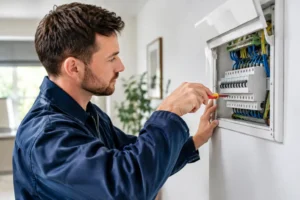
Older properties can introduce another layer. Roof condition, cable routes and consumer unit capacity may all need reviewing before installation. This is where having an installer with broader electrical expertise is genuinely useful. Solar does not sit in isolation from the rest of your property.
Premium vs mid-range panels
For many households, this is the real buying decision. Premium panels usually offer higher efficiency, longer warranties and lower degradation. Mid-range panels often provide very good performance at a more comfortable upfront cost.
If you expect to stay in your home for many years, have limited roof space and want to maximise generation, premium panels are often easier to justify. If your roof has ample space and you are focused on a sensible payback period, a well-chosen mid-range panel can be the better buy.
There is no shame in choosing value. The goal is not to win a specification contest. It is to install a system that performs reliably and makes financial sense.
Don’t judge panels without looking at the whole system
Panels get most of the attention, but they are only one part of the job. Inverter quality, mounting system, generation estimates and installation standards all affect the final result. A great panel badly installed is still a poor investment.
That is why homeowners should be wary of quotes that focus heavily on panel headlines while saying very little about design, expected output or aftercare. The best systems are properly surveyed, accurately sized and installed to recognised standards by an accredited team.
A household with daytime usage might benefit from one setup, while a family out all day could get better value by pairing solar with battery storage. If you are also considering an EV charger or future heating upgrades, those plans should be part of the conversation early on.
What should UK homeowners actually look for?
In straightforward terms, look for monocrystalline panels from a reputable manufacturer, strong product and performance warranties, and realistic generation forecasts based on your roof rather than generic assumptions. Ask how the system will perform in winter, what shading has been allowed for and whether the design leaves room for battery storage later.
You should also ask who is carrying out the work and what accreditations back it up. Solar is one of those purchases where the installer matters nearly as much as the equipment. MCS certification, TrustMark registration and solid electrical credentials are not box-ticking exercises. They are part of how you reduce risk.
For homeowners in the North East, local knowledge has value as well. An installer who understands the housing stock, weather conditions and practical realities of homes in this region is often in a better position to recommend the right setup than someone working from a one-size-fits-all script. That grounded, fully managed approach is exactly why many customers come to SWH Electrical Solutions.
So, which are the best domestic solar panels?
The honest answer is that the best domestic solar panels are the ones that suit your roof, your energy habits and your long-term plans. In most cases, that will mean a quality monocrystalline panel from a trusted manufacturer, installed as part of a properly designed system by an accredited installer.
If your roof space is tight, lean towards higher-efficiency premium panels. If you have more room and want the numbers to stack up sooner, good mid-range panels may be the smarter choice. If shading, battery storage or future electrical upgrades are part of the picture, the wider system design matters just as much as the panel badge.
A sensible solar investment is rarely about chasing the fanciest option. It is about choosing equipment that works well in British conditions, fits your property properly and keeps delivering long after the scaffolding has gone. That is usually where the best results, and the best value, are found.