A home EV charger can be one of the largest electricity demands in a household. So, can solar panels charge EVs and make every journey cheaper? Yes – but the most cost-effective setup is not usually as simple as connecting a car to panels on the roof.
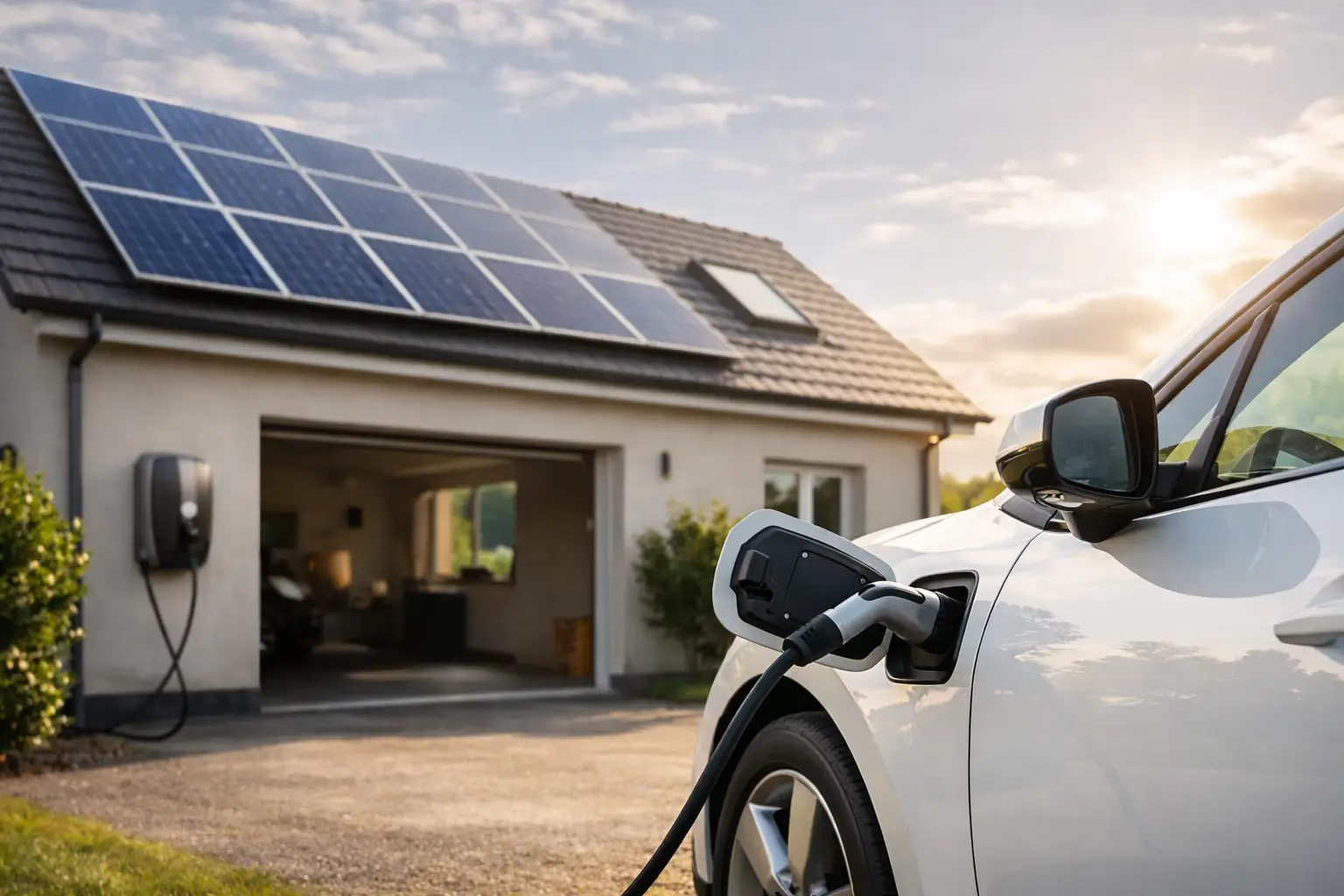
In a typical UK installation, your solar panels generate electricity that first serves the property. A compatible EV charger can then use available solar generation to charge the vehicle, while drawing extra power from the grid whenever the car needs more than the panels are producing. With the right design, smart charging controls and expectations, solar can make a meaningful dent in the cost of electric motoring.
Can solar panels charge EVs directly?
Solar panels can charge an EV, but they do not normally connect directly to the car. Panels produce DC electricity, whereas most domestic EV chargers use AC electricity supplied through your home’s consumer unit. A solar inverter converts the power from the panels, and the charger safely manages the supply to the vehicle.
This arrangement also means your household appliances, battery storage system and EV charger can work together. If the sun is producing more electricity than your home is using, a smart charger can detect that surplus and send it to the car. If a cloud passes over or a kettle goes on, the charger can reduce its output to avoid importing more electricity than you intend.
That is a safer and more useful approach than trying to create a dedicated panel-to-car connection. It gives you flexibility: charge from solar when it is available, use a lower-cost off-peak tariff when it is not, and always have the reliability of the grid when you need to leave at a set time.
How much solar power does an EV need?
The answer depends on your driving, the efficiency of your EV, your roof and the season. As a broad guide, an electric car may travel around three to four miles for every kWh of electricity used. A car driven 8,000 miles a year could therefore use roughly 2,000 to 2,700 kWh for charging across the year.
A well-sited 4 kW domestic solar system might generate around 3,200 to 4,000 kWh annually in the UK. Generation is generally lower in the North East than in the sunnier parts of the country, but solar remains a worthwhile option for many homes. It can cover a substantial share of annual EV charging demand, particularly where charging is flexible and takes place during daylight hours.
The annual figures tell only part of the story. Solar output is highest in spring and summer, often when household demand is modest during the day. Winter brings shorter days, lower sun angles and higher electricity use at home. You may charge a large proportion of your EV from surplus solar in summer, then rely more on the grid or an off-peak tariff in winter.
A standard 7 kW home charger also draws more power than most domestic solar arrays produce at any one time. A 4 kW system, for example, cannot continuously provide 7 kW on its own. The charger can still run, but the difference will come from the grid unless it is set to slow down and follow solar surplus.
Solar-only charging versus solar-assisted charging
Solar-only charging means the charger waits until there is sufficient spare generation and adjusts its charging rate to match it. This maximises the use of self-generated electricity, but it can be slow and unpredictable. It works particularly well for drivers who are at home during the day, have a second vehicle, work flexible hours or can leave the car plugged in for long periods.
Solar-assisted charging is more practical for many households. You can set the charger to prioritise surplus solar, then use grid electricity when needed. If you need a full battery for an early start, the charger can be scheduled to finish overnight on a favourable EV tariff rather than leaving your plans to the weather.
What makes a solar EV charging setup work well?
The right system starts with the property, not the charger. Roof orientation, pitch, shading, available roof area and your existing electricity use all affect what solar system size makes sense. Your travel pattern matters just as much. A household with an EV sitting on the drive every weekday may use solar very differently from someone commuting 60 miles a day.
A smart EV charge point is central to the setup. Look for solar surplus capability, scheduled charging and load balancing. Load balancing monitors the property’s overall demand and can prevent the charger from overloading the incoming supply when other high-demand equipment is running, such as an electric shower, induction hob or heat pump.
It is also worth considering how you currently use daytime electricity. A home office, washing machine, dishwasher or immersion heater can consume solar output before it reaches the car. This is not a problem – using your own solar power is still valuable – but it affects how much surplus is available for charging.
For commercial sites, the principle is similar but the assessment is more detailed. Fleet charging, operating hours, building demand, parking layout and electrical capacity all need to be considered together. A workplace where vehicles are parked for much of the day can be an excellent fit for solar-assisted charging, provided the system is designed around actual usage rather than headline panel capacity.
Is a home battery necessary?
No. Solar panels and a smart EV charger can work effectively without battery storage. In fact, if your car is at home in daylight, it can act as a very useful destination for excess solar generation without the upfront cost of a home battery.
Battery storage becomes attractive where solar is generated while the car is away, or where you want to use stored power in the evening. It can also help households make better use of low-cost overnight electricity. However, charging an EV from a home battery needs careful thought. Every time electricity is stored and released, there are conversion losses, and repeated high-power charging can use a significant share of the battery’s capacity.
For some homes, the best order is solar first, a properly integrated EV charger second, and battery storage later once energy use is understood. For others, especially properties with high evening demand or plans for a heat pump, an integrated solar, battery and charging design can be the better long-term investment.
Do you still need grid electricity?
In most cases, yes. The grid provides the certainty that solar alone cannot offer through darker months, poor weather and urgent journeys. That does not mean solar has failed to deliver value. Every kWh generated and used at home or in your car reduces the electricity you need to buy at the prevailing rate.
The strongest financial case often comes from combining solar charging with a suitable EV electricity tariff. Use surplus solar whenever it is available, then schedule charging for low-cost overnight periods when it is not. This approach can be more reliable than insisting on solar-only charging and is often kinder to your routine.
Export payments should also be part of the calculation. If your solar electricity could otherwise be exported for a payment, the saving from putting it into the EV is the difference between your import price and export rate. A professional survey can compare these figures against your likely charging habits rather than relying on generic estimates.
Planning an installation safely
An EV charger is a significant electrical load, and solar equipment must be designed around the property’s supply, earthing arrangement and consumer unit capacity. The installation may require notifications to the Distribution Network Operator, particularly where generation or charging capacity affects the local network. These details are routine for a competent installer, but they should never be treated as an afterthought.
It also pays to plan ahead. If you are considering solar, battery storage, an electric vehicle and a heat pump over the next few years, tell your installer at the start. Designing the cabling, consumer unit capacity and monitoring around the full picture can reduce disruption and avoid unnecessary alterations later.
At SWH Electrical Solutions, this joined-up approach allows solar, EV charging and wider electrical work to be considered as one property energy system, not separate jobs competing for the same supply.
The practical goal is not to promise that your car will run on sunshine every day of the year. It is to create a system that uses as much of your own generation as sensibly possible, charges reliably when life demands it and keeps your energy costs moving in the right direction.