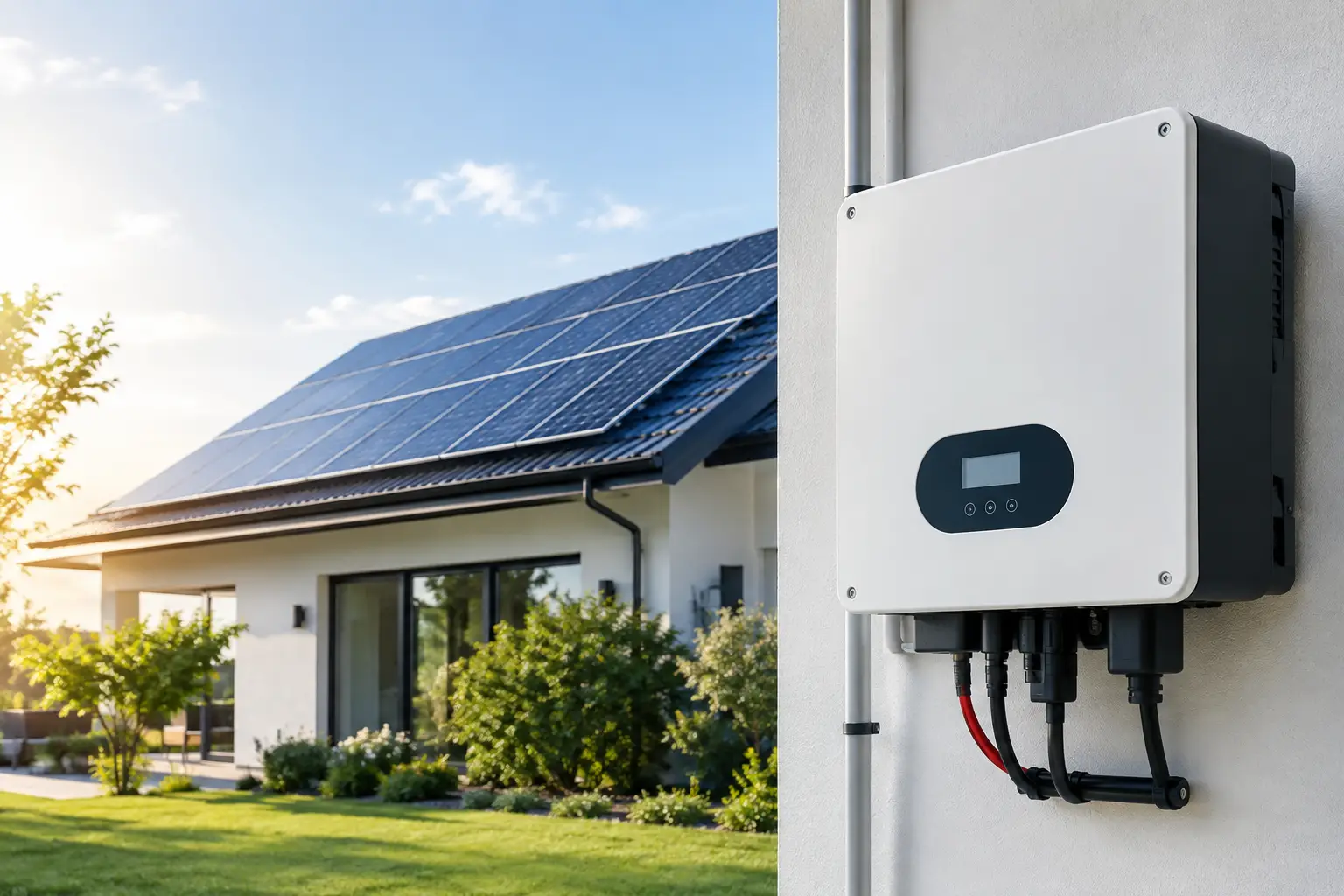
A solar inverter is the part of a solar PV system that decides whether the energy from your roof is genuinely useful in your property. Panels may get most of the attention, but they produce direct current (DC), while homes and businesses use alternating current (AC). The inverter converts one into the other, manages how the system performs and helps you see what your solar is producing.
For a homeowner looking to reduce electricity bills, a business managing daytime energy use, or a developer planning an efficient new build, choosing the right inverter is not a minor specification. It affects generation, battery options, monitoring, safety and the value you get from the installation over many years.
What does a solar inverter do?
At its simplest, an inverter changes the DC electricity generated by solar panels into AC electricity for lights, appliances, machinery and other electrical loads. It also continuously adjusts its operation to get the best available output from the panels as sunlight, temperature and shading change through the day.
Most modern units use maximum power point tracking, usually called MPPT. This technology identifies the voltage and current at which a string of panels is working most effectively. Where a roof has panels facing different directions, separate MPPT inputs can allow each group to operate independently rather than holding the other back.
The inverter is also a safety device. A grid-connected system must disconnect if there is a power cut on the local network. This prevents solar electricity feeding into cables that engineers may be working on. It means ordinary solar PV will normally switch off during a power cut, even if the sun is shining. Backup power requires the right inverter, battery arrangement and changeover equipment to be designed in from the outset.
Choosing the right solar inverter type
There is no universal best choice. The right approach depends on roof layout, shading, electricity use, future battery plans and the scale of the project.
String inverters
A string inverter is the standard option for many domestic and commercial installations. Panels are connected in series as a string, or in several strings, and the inverter is installed at a suitable accessible point. This is often a cost-effective, proven solution for roofs with clear exposure and a straightforward layout.
The limitation is that panels in the same string are linked electrically. If one panel is significantly shaded or underperforming, it can reduce the output of the group. Good design can often minimise this issue by keeping differently orientated roof sections on separate strings and using the available MPPT inputs properly.
Microinverters and optimisers
Microinverters are fitted at individual panels, converting DC to AC on the roof. Power optimisers sit at each panel but generally work with a central inverter. Both can be useful where a roof has chimneys, dormers, trees or several orientations that create uneven shading.
Their key advantage is panel-level performance management and, depending on the system, more detailed monitoring. The trade-off is higher equipment cost and more electronics on the roof. They are not automatically necessary for every home. On an open, simple roof, a well-specified string inverter may be the more sensible investment.
Hybrid inverters
A hybrid solar inverter is designed to work with solar panels and a compatible battery. It can direct generated electricity to the property, battery or grid according to system settings and household demand. For customers who expect to add storage soon, fitting a hybrid unit from the start can avoid replacing a perfectly serviceable inverter later.
That said, not every battery installation requires a hybrid inverter. AC-coupled batteries can be added to existing solar systems and can be a practical option where the original inverter is relatively new. The best route depends on the age of the PV system, the battery capacity required and whether backup power is a priority.
Getting the inverter size right
Inverter capacity is measured in kilowatts (kW), but it should not simply match the combined panel rating on paper. A solar array may be deliberately larger than the inverter’s AC output rating. This is known as DC oversizing.
Panels rarely reach their headline output in real UK conditions. By using a slightly smaller inverter than the total panel capacity, the system can generate strongly for more of the morning, afternoon and lower-light periods. At times of exceptional sunshine, the inverter may cap output briefly. This is called clipping, and a sensible level of it can be an acceptable trade-off for better annual generation and equipment value.
However, oversizing has limits. The inverter must be compatible with the maximum DC voltage and current of the panels, and the design must account for cold-weather voltage increases. Grid connection permissions, cable sizes, protective devices and the property’s supply also matter. This is why an on-site survey and proper system design are worth far more than selecting an inverter from a price list.
For commercial sites, the question goes beyond annual generation. Half-hourly demand profiles, operating hours and export arrangements should shape the design. A warehouse that uses most of its power through the day may benefit from a different inverter and array configuration than an office that is quiet after 5pm.
Location, noise and practical access
An inverter needs a location with adequate ventilation, sensible cable routes and enough space for safe inspection or replacement. A garage, utility room or protected plant area is often suitable. Lofts can work in some cases, but high summer temperatures may reduce efficiency and make future servicing less convenient.
Inverters make a low operational hum and, in some conditions, fans may run. This is another reason to avoid placing one next to a bedroom or main living area where possible. Outdoor-rated units can be installed externally when the design calls for it, but they still need protection from avoidable heat, physical damage and poor cable routing.
For new builds and renovations, planning the inverter position early makes a real difference. Leaving space for a battery, consumer unit changes, isolators and metering equipment can prevent costly alterations once walls are finished.
Monitoring turns generation into useful information
Most quality inverters provide an app or online portal. It should show generation, household consumption where monitoring is fitted, export and battery behaviour. Used well, that information helps owners move flexible use into sunny periods – for example, running a dishwasher, charging an EV or heating water when solar output is high.
Monitoring is also an early warning system. A sudden reduction in output, an error message or one string producing less than expected may point to a fault that needs attention. It does not replace professional maintenance, but it makes performance visible instead of leaving you to guess from a quarterly bill.
For businesses, monitoring can support practical energy decisions. It can show whether solar is matching daytime demand, whether a battery may be worthwhile and whether plant or equipment is creating avoidable peaks in electricity use.
Reliability, warranties and maintenance
A solar inverter will not necessarily last as long as the panels themselves. Panels may carry performance warranties of 25 years or more, while inverter warranties are commonly shorter, though many manufacturers offer extensions. It is sensible to ask what is covered, who manages a warranty claim and whether labour is included if a replacement is needed.
Keep the inverter clear of stored items and check the monitoring platform periodically. If warning lights appear, generation drops unexpectedly or the unit repeatedly shuts down, arrange a qualified inspection rather than resetting it again and again. Problems can relate to the inverter, but they may also involve the grid, isolators, cabling, panels or communication equipment.
A properly installed system should include suitable electrical protection, clear labelling, commissioning records and a handover that explains normal operation. For installations eligible for schemes and export payments, using an MCS-certified contractor is particularly important. Certification and competent electrical work are not paperwork extras – they protect the system, the property and your ability to demonstrate it has been installed correctly.
Plan for how you will use solar, not just how much you can fit
The most effective solar design starts with your electricity habits. A family working from home may prioritise daytime self-consumption. A business may want to reduce predictable daytime demand. A developer may need a repeatable specification that supports modern energy standards and leaves residents ready for EV charging and battery storage.
SWH Electrical Solutions designs solar systems around those practical questions, combining PV work with the electrical expertise needed for batteries, EV chargers and wider property upgrades. A clear survey should cover roof condition, shading, electrical supply, likely future demand and the equipment that will make the system easiest to live with.
A well-chosen inverter should quietly do its job for years: converting clean generation safely, making performance easy to understand and giving you options as your energy use changes. Start with the building and the way it is used, and the right equipment choice becomes much clearer.