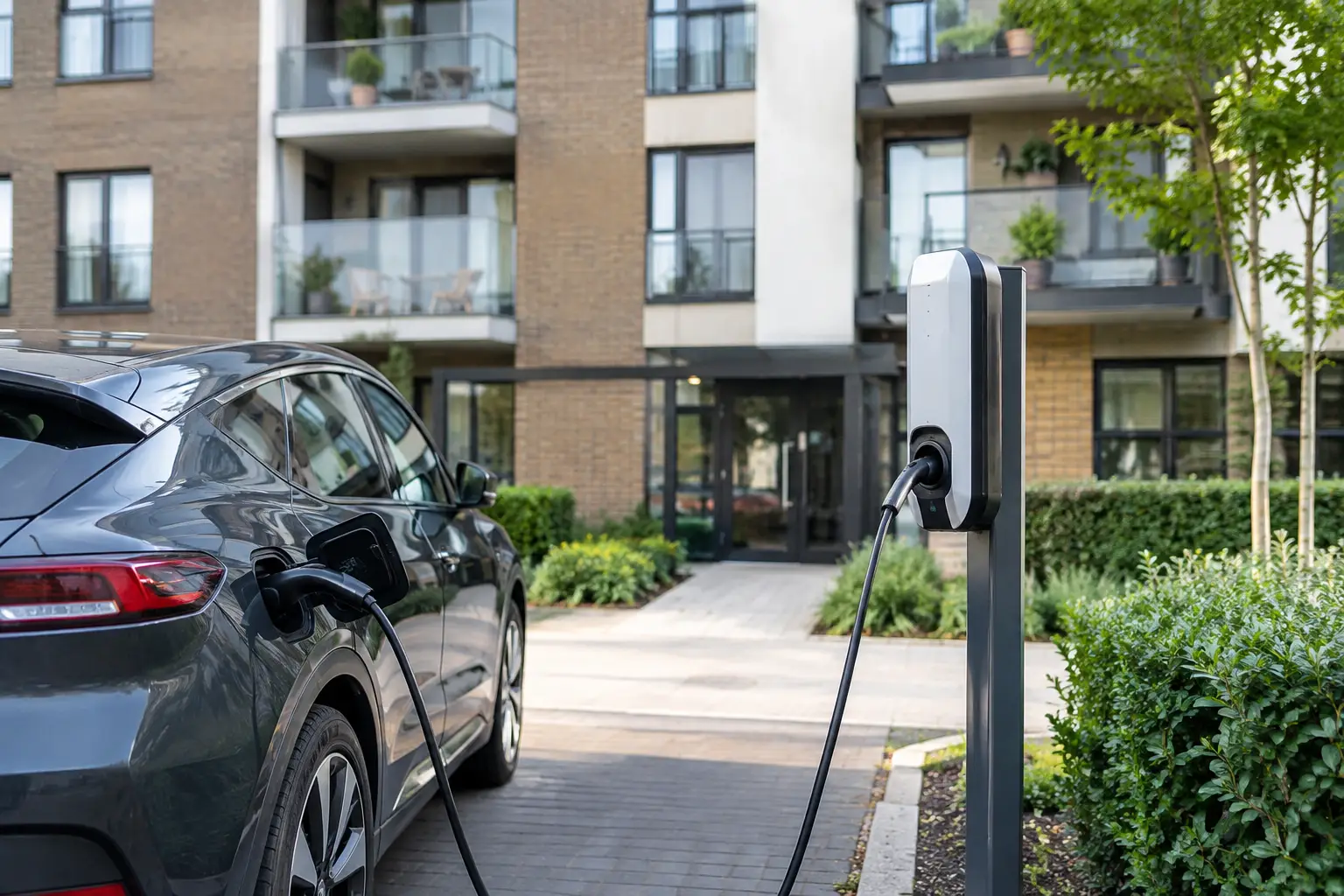
A resident arriving home with 12% battery left does not need a headline-grabbing solution. They need a charge point by their allocated bay that works overnight, bills them fairly and does not create a headache for the building manager. That is the practical challenge of flat EV charging in UK blocks of flats.
For houses, the answer is often straightforward: survey the supply, fit a suitable unit and arrange the cable route. Flats are different. Parking may be communal, electrical supplies may serve an entire block, and the person wanting a charger may not own the land where it needs to sit. A successful scheme starts by treating it as a shared property and electrical infrastructure project, not simply a single charge point installation.
Why flat EV charging needs a different approach
The biggest issue is usually ownership. A leaseholder may own their flat but have only a right to use a parking space. The freeholder, managing agent or residents’ management company may control the car park, external walls, meter cupboards and communal electrical intake. Before any design work progresses, the relevant permissions need to be clear.
That does not mean charging is out of reach. It means everyone benefits from a considered plan. A one-off installation can be appropriate where there is a privately owned space and a simple cable route from the resident’s own meter. In a larger communal car park, however, installing the first charger without thinking about the next ten can leave the block with costly alterations later.
The electrical capacity of the building also matters. EV charge points can add a significant load, particularly if several vehicles charge at the same time during the evening. A competent survey should look beyond the available space on a consumer unit. It should assess the incoming supply, existing communal demand, cable routes, earthing arrangements, distribution boards and whether the local network has sufficient capacity.
Planning flat EV charging in a block of flats
The most effective projects begin with a site survey and a short conversation between the people who make decisions for the building. For leaseholders, that could mean approaching the managing agent with a clear request rather than arranging work independently. For landlords and property managers, it means establishing demand across the block before committing to a design.
A survey can establish whether individual supplies are practical, whether a dedicated communal charging supply would be better, and how future bays could be connected. This early work is where a good installer earns their keep. The lowest initial quote is not always the best value if it creates a restricted, difficult-to-expand system.
Individual supply or communal infrastructure?
Where bays sit close to the building and each flat has an accessible meter position, a charge point connected to an individual flat supply can be a sensible route. The resident pays for electricity through their existing tariff, and billing is relatively simple. The trade-off is that multiple separate cable runs can become untidy, disruptive and expensive across a large site.
A communal system normally uses a dedicated supply or distribution arrangement for the car park. Users then pay through a charging platform, RFID card or app, depending on the equipment selected. This is often more appropriate for developments with unallocated spaces, rental properties or several residents expecting to switch to electric vehicles over time.
Communal systems need sensible management rules. Someone must decide who can use the bays, how tariffs are set, how maintenance is funded and what happens when demand grows. These points are easier to agree before equipment is installed than after the first charging bay becomes a source of neighbourly debate.
Load management protects the building supply
Load management is one of the most valuable features for multi-residential charging. Rather than allowing every charger to draw maximum power at once, the system monitors available capacity and shares it between connected vehicles. Charging may slow temporarily at peak demand, but residents can still plug in and receive a useful overnight charge.
This approach can avoid or delay an expensive supply upgrade. It is particularly useful where a block has electric heating, lifts, communal lighting or other fluctuating loads. The right settings depend on the site, the number of charge points and expected driving patterns, which is why generic designs rarely suit every building.
Permissions, compliance and resident confidence
A charge point in a communal area is not just an electrical installation. It is an alteration to shared property. Lease terms may require freeholder consent, and managing agents may need to consult residents or obtain approval from a management company board. Listed buildings, conservation areas and unusual parking arrangements can introduce further considerations.
A clear proposal helps move these conversations along. It should set out the proposed charger locations, cable routes, how access will be managed, who owns the equipment and how reinstatement would be handled if a resident moves away. The aim is to demonstrate that the work will be safe, neat and properly maintained, not to present other residents with a fait accompli.
Electrical work should be designed and installed by a competent contractor, with appropriate certification provided on completion. The installation needs to account for outdoor equipment, impact protection where required, isolation, earthing and the manufacturer’s requirements. A proper design also considers the route from the electrical intake to the car park, rather than simply choosing the shortest line on a drawing.
For property managers, documentation matters. Keep electrical certificates, equipment details, maintenance information and records of any permissions together. It makes future inspections, repairs and additional installations far less complicated.
Cost: what owners and managers should budget for
The charge point itself is only one part of the cost. Civil works, trenching, containment, long cable runs, distribution equipment, protective bollards and electrical supply upgrades can all affect the final figure. A bay beside an external meter cupboard is a different proposition from a space at the far end of an underground car park.
It is worth separating immediate costs from future-proofing costs. Installing ducting and spare capacity while other groundworks are taking place can be much cheaper than digging up the same surface again in two years. Developers have a particular opportunity here: allowing for charging infrastructure during construction is normally simpler than retrofitting it once residents have moved in.
There are also ongoing costs to consider. These may include network or back-office fees for communal systems, electricity administration, periodic inspection, repairs and any management time needed to oversee access. A transparent charging tariff can recover these costs without creating confusion for residents.
Funding models vary. In some buildings, the first requesting resident pays for their own connection while the management company funds shared enabling works. In others, the landlord or freeholder invests in infrastructure as an amenity and recovers costs through use. There is no single right answer, but the arrangement should be written down before work begins.
Designing for growth, not just the first EV
A sensible flat EV charging design does not need to install chargers in every bay on day one. It should, however, make expansion realistic. That can mean fitting a larger distribution board, leaving spare ways, installing containment for future cables or preparing duct routes beneath the car park surface.
For existing blocks, a phased rollout is often the practical option. Start with a small number of bays and a load-managed system, then add charge points as resident demand rises. This spreads capital costs while avoiding a dead end after the first phase.
For new-build developments, charging should be discussed alongside solar, battery storage, heating design and the wider electrical strategy. These systems can interact. For example, a development with solar generation may benefit from controls that encourage daytime workplace or visitor charging, while battery storage can support broader site energy goals. The detail depends on the building’s supply arrangement and how residents will be billed.
Questions worth asking before approving a scheme
Before proceeding, a freeholder, developer or managing agent should be able to answer a few practical questions. Who has authority to approve the works? How many residents are likely to want charging in the next three to five years? Is there sufficient capacity now, and if not, can smart load management or a supply upgrade address it? Finally, who will operate, maintain and pay for the system once it is live?
If those answers are vague, pause before choosing equipment. A little more planning at this stage can prevent stranded cables, disputes over electricity costs and repeat disruption to the car park.
For leaseholders, the best first step is usually a polite, well-prepared request to the managing agent or freeholder. Explain where you park, whether the bay is allocated, the charging requirement and your willingness to use an approved installer. Asking whether the building has an existing EV charging policy can also reveal whether a wider scheme is already being considered.
For developers and block managers across the North East, SWH Electrical Solutions can survey the site, advise on practical options and deliver an installation built around the building rather than a one-size-fits-all package. The right outcome is simple: residents can charge with confidence, while the property remains safe, orderly and ready for the next wave of electric vehicles.