A home charge point is not simply a socket added to an outside wall. How EV chargers are installed depends on the capacity and condition of the existing electrical supply, where the vehicle is parked, the charger selected, and whether the property needs work to support it safely. Getting those decisions right at the start means reliable charging, a tidy finish and no unpleasant surprises when the electrician arrives.
For most homeowners, the physical installation can be completed in a day. Commercial sites and new developments may take longer because their power demand, cable routes and distribution equipment need more detailed planning. In every case, a competent electrician should manage the process from survey through to testing, certification and handover.
The installation starts with a proper survey
Before recommending a charger, an electrician needs to understand the property and how it is used. At a home, that usually means checking the electricity meter position, consumer unit, incoming supply, driveway or garage, and the practical route for the charging cable. The aim is to place the unit where it is convenient to use without creating a trip risk or leaving cables stretched across a pavement.
The survey also establishes what sort of charger suits the vehicle and household. A 7kW charge point is a common choice for homes with a single-phase supply, giving most drivers a useful overnight charge. Some properties and commercial premises have three-phase supplies, which can support higher charging rates where the vehicle and charger are compatible.
It is not always best to choose the highest-rated unit. A charger should fit the property’s available capacity and the driver’s real routine. If a car is parked at home for ten hours each night, controlled overnight charging may be more useful than paying for equipment that the supply cannot support without upgrades.
Choosing the location
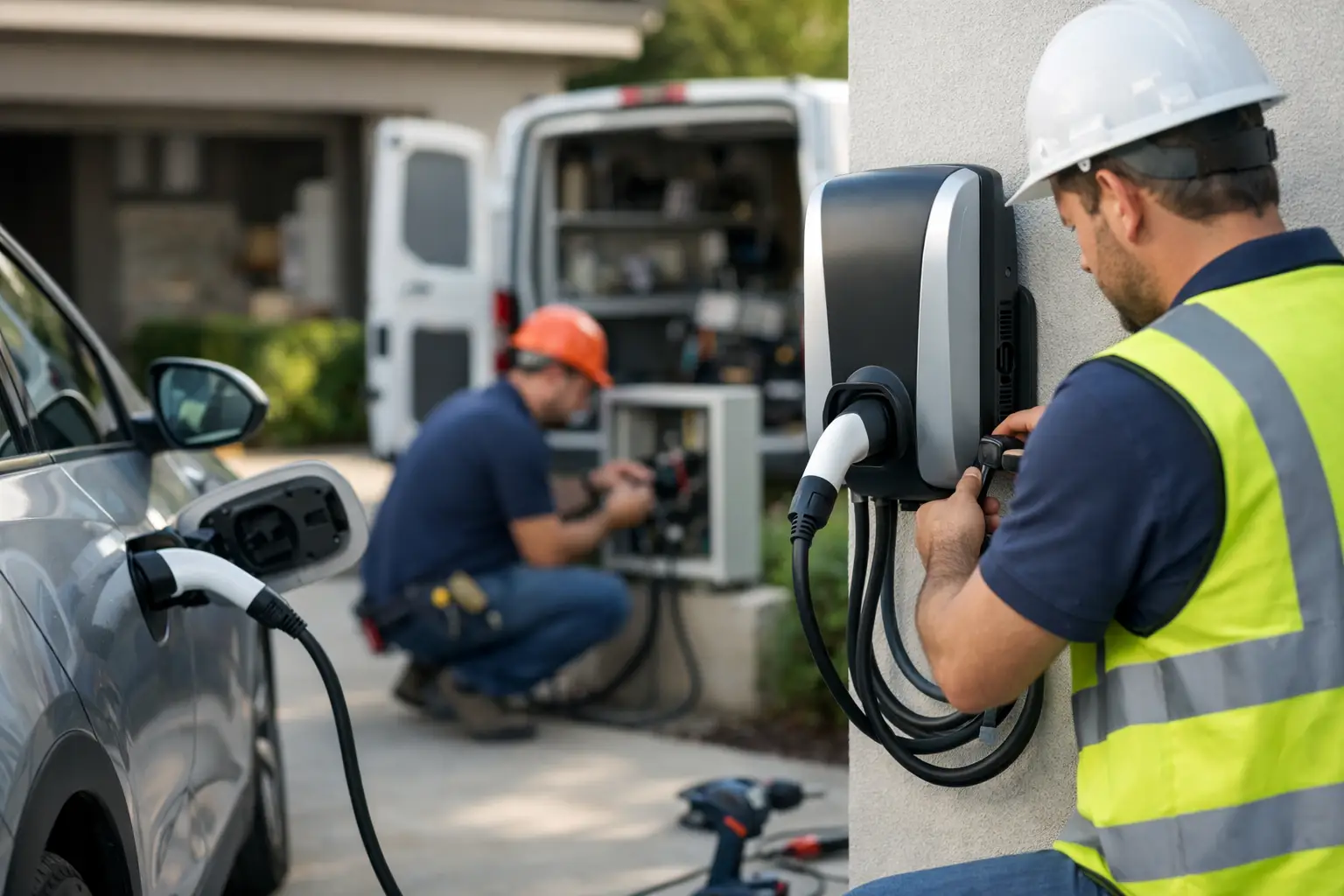
Wall-mounted units are often fitted beside a driveway, garage entrance or car port. A pedestal may be the better option where there is no suitable wall, particularly in communal parking areas or commercial car parks. The installer will consider weather exposure, cable length, accessibility and the charger manufacturer’s clearance requirements.
At workplaces, location planning also needs to account for vehicle circulation, marked parking bays and future expansion. Installing containment or allowing spare capacity at the outset can make it far less disruptive to add charge points later.
Checking the electrical supply and consumer unit
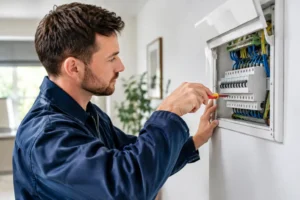
The electrical checks are the part of the job that should never be rushed. An EV charger is a significant additional load, often running for several hours at a time. The installer assesses the incoming supply, main fuse rating, earthing arrangement and condition of the consumer unit to make sure the system can accommodate it.
A modern consumer unit with spare ways may be suitable for a dedicated circuit. In other properties, the board may be full, outdated or not compatible with the protection required for the proposed charger. That does not mean charging at home is impossible. It may mean the installation needs an upgrade, an additional small consumer unit or another carefully designed solution.
The electrician also checks whether the electricity network operator needs to be notified. In the UK, charge point installations are generally reported under the relevant connection process, and some higher-load arrangements need agreement before installation. A competent installer handles this as part of the job, rather than leaving the customer to decipher technical forms.
Load balancing prevents overloads
Many smart chargers include load balancing, sometimes called load management. This measures or monitors the property’s electricity demand and automatically reduces the charging rate when other high-demand appliances are running. When demand drops, the charger can increase again.
This is particularly useful in homes with electric showers, induction hobs, heat pumps or electric heating. It can also help commercial premises make better use of their existing supply when several vehicles charge at once. Load balancing is not a substitute for a sound electrical design, but it is often a practical way to protect the supply and avoid unnecessary upgrades.
Installing the dedicated circuit and charger
Once the design is agreed, the electrician isolates the relevant supply and installs a dedicated circuit for the charger. This typically includes appropriately sized cabling, suitable protective devices and isolation equipment. Cable size is not guessed: it is calculated around the charger rating, cable length, installation method and conditions along the route.
The cable might run through a loft, garage, under-floor space, surface trunking or external-grade containment. A good installation is about more than making the charger work. Routes should be secure, protected from damage, weather-resistant where needed and as discreet as the building allows.
The charger is then fixed in its chosen position and connected in line with the manufacturer’s instructions and current electrical requirements. Outdoor equipment is selected and installed with the right level of protection against water and impact. Where cable runs cross gardens, drives or parking areas, the method must be suitable for that environment rather than relying on a quick cosmetic fix.
At a commercial site, the work may involve a local distribution board, underground ducts, parking-bay protection or multiple pedestal units. The principle is the same, but coordination matters more. The installation needs to work alongside the building’s day-to-day operation, fire strategy and wider electrical infrastructure.
Smart charging, solar and battery storage
A smart charge point can be scheduled to charge at cheaper off-peak tariff times, helping households and businesses control running costs. Most models connect through Wi-Fi, Ethernet or mobile data, allowing the owner to set schedules, view energy use and manage access through an app.
For properties with solar panels, the charger can sometimes be configured to prioritise surplus generation. This can be an excellent fit for drivers who are regularly at home during daylight hours, but it is worth keeping expectations realistic. Solar output changes with the season, weather and household consumption, so many owners use a mix of solar-led and grid charging.
Battery storage adds another layer of choice. It may help a household use more self-generated energy, but a battery does not automatically make every charging arrangement cheaper. The best setup depends on the battery capacity, tariff, vehicle use and the controls available across the system. An electrician with experience in solar, batteries and charge points can design these systems to work together rather than as separate add-ons.
Testing, certification and handover
Before an EV charger is put into service, the circuit must be inspected and tested. This confirms that protective devices operate correctly, earthing arrangements are suitable, connections are sound and the charger performs as intended. The installer should also check the smart features, charging lead operation and any load-management settings.
Electrical installation work must comply with BS 7671, commonly known as the IET Wiring Regulations. The customer should receive the appropriate electrical certification and clear information on using the charge point. For domestic work, the installer will also deal with the relevant Building Regulations notification where required.
The handover is a useful opportunity to ask practical questions. How do charging schedules work? What happens if Wi-Fi drops out? Can another driver use the unit? Where is the isolation switch? A good installer explains the answers in plain English, not a cloud of electrical jargon.
What can affect cost and timescale?
A straightforward wall-mounted charger close to a suitable consumer unit is usually the simplest type of installation. Costs and timescales rise where long cable runs, groundworks, consumer unit upgrades, supply upgrades or difficult access are involved. Older homes can need extra investigation, while listed buildings and flats may need permissions or agreement from a landlord, managing agent or freeholder.
For businesses, the bigger question is often future demand. Installing two chargers today may be sensible, but planning the electrical capacity and cable routes for ten can prevent a much larger bill later. This is where a site survey earns its keep.
SWH Electrical Solutions approaches charge point work as part of the wider electrical picture, whether that means a straightforward home installation or a solar-led charging plan for a growing business. The right charger is the one that fits your property, your vehicle and the way you actually use energy – safely, neatly and with room for what comes next.