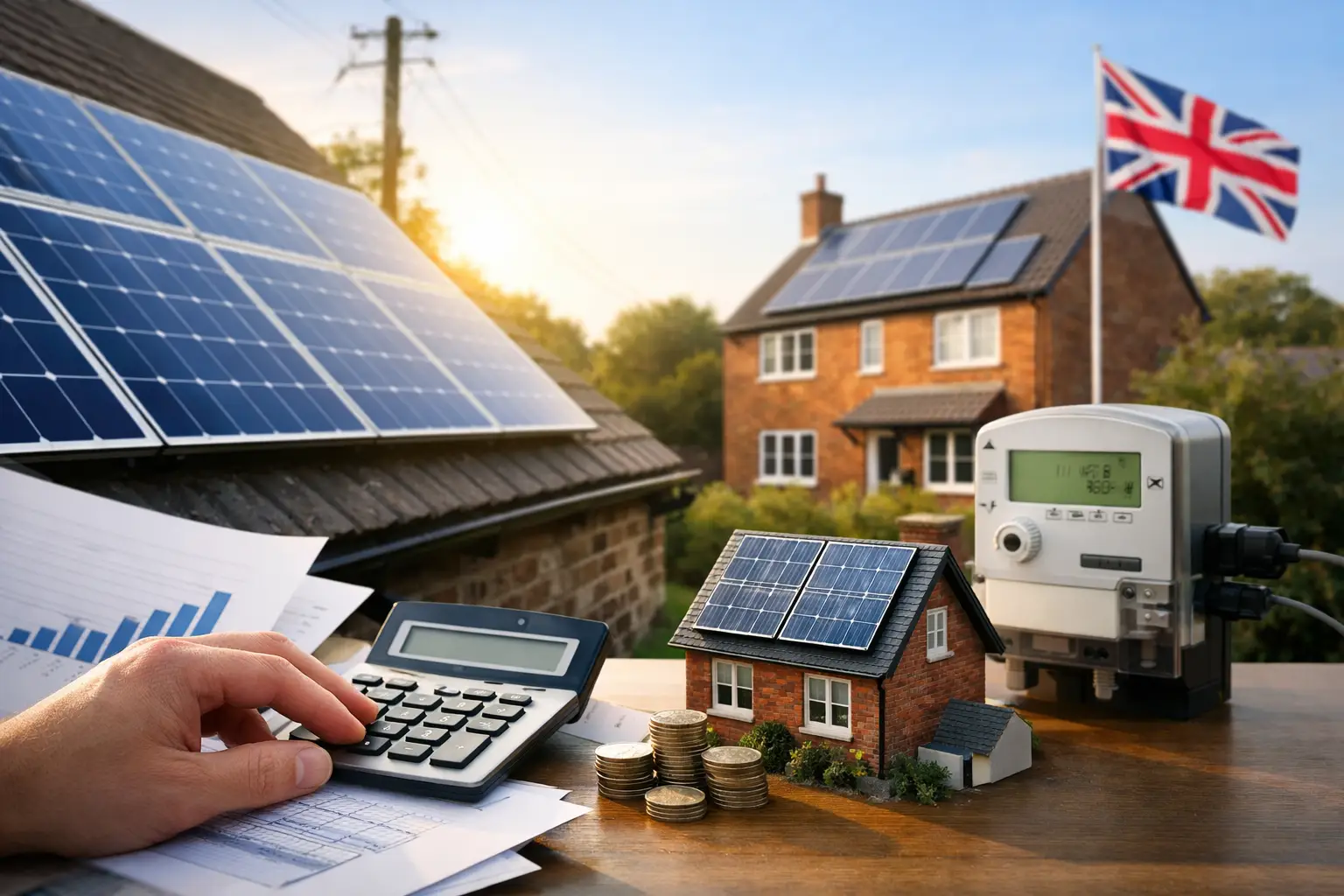
A solar export tariff explained properly starts with one simple point: your panels do not only save money when they power your home. When they generate more electricity than you can use, the surplus can be sent to the grid and you can be paid for it.
For many households, that payment is a useful part of the financial case for solar. It is not usually the biggest saving – using your own solar electricity remains more valuable than selling it – but it means less energy goes to waste on bright days when nobody is home.
What is a solar export tariff?
A solar export tariff pays you for each unit of renewable electricity exported from your property to the national grid. A unit is measured in kilowatt-hours (kWh), the same measurement used on your electricity bill.
In Great Britain, most modern export payments sit under the Smart Export Guarantee, usually shortened to SEG. Energy suppliers set their own rates and terms, so there is no single nationwide export price. One supplier may offer a fixed rate all day, while another may pay different amounts at different times.
The amount you receive is calculated separately from the electricity you buy. Your import tariff is what you pay when you need power from the grid. Your export tariff is what a supplier pays for electricity your solar system sends out. They may be provided by the same company, but they do not have to be.
How export payments work in practice
Picture a sunny weekday afternoon. Your solar panels are generating 3.5kW, but your home is only using 1kW for appliances, refrigeration and background demand. The remaining electricity will either charge a battery, if you have one and it has capacity, or be exported to the grid.
Your smart meter records that export. At the end of the billing period, your export supplier pays for the recorded number of kWh at its agreed rate.
For example, if you export 1,500kWh over a year and your tariff pays 12p per kWh, the export payment would be £180. The figures are purely illustrative. Actual generation, household use and tariff rates vary considerably, particularly between a compact home and a larger family property with higher daytime demand.
Export rates can change, and some tariffs have eligibility rules or require you to take a particular import tariff too. It is worth comparing the whole arrangement rather than focusing only on the headline export figure.
You need a suitable meter
Accurate export payments rely on a smart meter capable of recording half-hourly export data. Old generation meters may show how much your panels have produced, but that is not necessarily the same as what you have exported.
This distinction matters. If your solar array produces 4,000kWh in a year and your household uses 2,500kWh of that generation directly or through a battery, only the remaining exported amount is paid under an export tariff.
Before choosing a tariff, check that your meter is working properly and that your supplier has set up export readings. This can prevent a frustrating delay after a new solar installation.
Your installation must meet the scheme rules
To receive SEG payments, a domestic solar installation normally needs to be certified under the Microgeneration Certification Scheme, or an equivalent recognised certification route. You will also need the relevant documentation for the system and its connection.
This is one reason accredited design and installation matter. The paperwork is not an afterthought: it supports your application for export payments, gives you a clear record of the equipment installed and helps protect the long-term value of the work.
A competent installer will also manage the required notification or application process with the local electricity network operator. In the North East, as elsewhere, the network must know that generation has been connected to its system. The route depends on the size and design of the installation.
Why self-use is usually worth more than exporting
There can be a temptation to chase the highest export tariff. That can make sense in the right circumstances, but it should not distract from the main value of solar: reducing the electricity you need to buy.
Every kWh you use from your panels is one you do not need to import at your normal electricity rate. Since import electricity commonly costs more per unit than a standard export payment, using solar power in the home is often the stronger saving.
That does not mean exporting is a poor outcome. It is simply the next best use for genuine surplus. A well-designed system balances panel size, expected usage and future needs rather than being designed around export income alone.
Households can improve self-consumption by running appliances when solar production is high. Timers can help with washing machines, dishwashers and tumble dryers, provided they are used safely and in line with the appliance instructions. An electric vehicle charger, hot water diverter or heat pump can also create useful daytime demand, though each should be planned around the property and its electrical capacity.
Does a battery improve export tariff returns?
A battery can change how much electricity you export, but it does not automatically increase your total return. Its strongest benefit for many homeowners is storing daytime solar generation for use later in the evening, reducing imported electricity when panels are no longer producing.
If a battery absorbs surplus solar that would otherwise have been exported, your export payment may fall. At the same time, your saving on imported electricity may rise. Whether that is worthwhile depends on the difference between your import and export rates, your household’s evening demand, battery size, seasonal generation and the tariff you are on.
Some time-of-use tariffs create another consideration. They may pay a higher export rate at certain times or offer lower overnight import prices. Battery systems can be configured to work with these arrangements, but the settings need to be sensible. Suppliers may have specific terms around exported electricity that has been grid charged rather than generated by solar, so always read the tariff conditions before assuming every exported unit will be paid at the advertised rate.
A battery is therefore not a compulsory add-on for solar. For a household that is occupied during the day, direct solar use may already be high. For a family out at work and school until late afternoon, storage can be more attractive. A proper survey should look at real consumption patterns rather than relying on a one-size-fits-all answer.
Choosing an export tariff without chasing the wrong number
The best export tariff is not always the tariff with the largest number beside it. A high rate may be tied to an import plan that is less suitable for your wider electricity use. Variable or agile-style pricing can work well for some households, but requires more attention to when energy is used and exported.
Start by looking at your likely annual generation and when you are at home. Then consider whether you plan to add a battery, EV charger, heat pump or electric heating in future. These changes can significantly alter the balance between importing, using and exporting electricity.
You should also check how often a supplier pays, whether it accepts customers with a different import supplier, and whether the tariff is fixed or variable. A few minutes spent reading the terms can be worth more than switching for a small headline difference.
What about Feed-in Tariff payments?
Older solar owners may be on the Feed-in Tariff, known as FiT, rather than SEG. FiT closed to new applicants in 2019, but existing eligible customers continue to receive payments under their original agreement.
FiT worked differently because it included a generation payment as well as an export payment, with some export historically deemed rather than measured. Do not assume a new export tariff works in the same way. If you are buying a property with older solar panels, ask the seller for the FiT paperwork and establish who receives the payments before completion.
Getting the most from a new solar system
A solar quote should show more than the number of panels and a projected annual generation figure. It should explain likely self-consumption, expected export, the assumptions behind savings and whether battery storage is suited to your routine.
At SWH Electrical Solutions, that conversation starts with the property, the roof and how electricity is genuinely used. For homeowners, businesses and developers, a correctly specified system and clear handover documentation make it far easier to choose an export tariff with confidence.
Solar export income is best treated as a useful extra, not a promise that every spare unit will transform your bills. Get the design right first, use as much clean power on site as practical, and let the export tariff reward the electricity you genuinely do not need.