A production line starts early, the office lights come on, refrigeration plant ramps up and an EV fleet returns to charge. For many North East businesses, those hours coincide with the most expensive electricity on the day. A guide to commercial battery storage should therefore begin with the real issue: not simply how much electricity your site uses, but when it uses it and what that timing costs.
Commercial battery storage allows a business to store electricity for use when it is more valuable. That electricity may come from an on-site solar array, the grid during lower-priced periods, or a combination of both. Done properly, it can cut peak demand, improve the value of solar generation and give a site more control over an increasingly complicated energy bill. It is not, however, a one-size-fits-all purchase. The best system is driven by half-hourly data, site constraints and a clear operating plan.
What commercial battery storage does
At its simplest, a battery stores direct current electricity and uses an inverter to make it available to the building as alternating current. The control system decides when to charge and discharge according to rules agreed during design. Those rules might prioritise using surplus solar, avoiding a high-cost evening peak, limiting the power imported by a large piece of equipment, or retaining a reserve for essential loads.
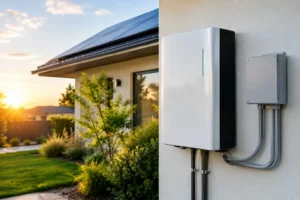
For a business with solar, the obvious benefit is moving daytime generation into the late afternoon, evening or early morning. Without a battery, unused solar may be exported for a modest payment while the same business later imports electricity at a much higher rate. A battery cannot remove every import cost, but it can make more of the energy generated on site useful to the business.
A battery can also work without solar. Some sites charge from the grid at off-peak rates and discharge during higher-priced periods. Whether this stacks up depends on the tariff, the battery’s efficiency, degradation over time and any network charges. It needs proper modelling, not a promising headline figure.
Where the strongest business case comes from
The return on commercial battery storage usually comes from several savings working together rather than one dramatic change. Solar self-consumption is often a major part of the picture, particularly for offices, warehouses, schools and other premises where solar generation exceeds daytime demand at certain times of year.
Peak shaving can be just as valuable. A site with a short but sharp demand spike – perhaps when ovens, pumps, compressors, lifts or vehicle chargers operate together – may be paying for capacity it only needs briefly. A correctly sized battery can discharge during that peak, reducing grid import. This requires close attention to power, measured in kilowatts, rather than just battery capacity, measured in kilowatt-hours.
Time-of-use tariffs are another opportunity. Electricity prices can vary significantly by time of day, but tariff savings are not automatic. If the difference between cheap and expensive periods is small, cycling the battery may not justify the energy losses and wear. Conversely, a business with predictable evening demand and a suitable tariff may see a much clearer benefit.
Resilience can matter too. Some systems can support selected circuits during a power cut, but this should never be assumed. Backup capability needs specific equipment, safe isolation from the grid and a realistic view of what loads the battery can support. Keeping emergency lighting, IT equipment, security systems or a critical control panel running is very different from supplying an entire factory.
Start with data, not a battery size
The most common mistake is choosing a battery by looking at a neighbour’s installation or selecting a capacity that sounds substantial. Commercial systems should be designed around at least a year of consumption data where possible, ideally in half-hourly intervals. That reveals seasonal changes, opening hours, load peaks and the relationship between demand and solar generation.
A site survey should also consider the incoming supply, distribution boards, available space, cable routes, fire strategy and access for installation and future maintenance. In older commercial properties, there may be electrical upgrades required before a battery is connected. Addressing those early prevents a project from becoming more disruptive or expensive halfway through.
Capacity and power are different decisions
Capacity tells you how much energy a battery can hold. A 100 kWh battery may, in theory, supply 100 kW for one hour or 25 kW for four hours, subject to the manufacturer’s operating limits. Power tells you how quickly it can charge or discharge.
A business seeking to capture excess solar over several hours may need more capacity. A business trying to stop a brief 80 kW import spike may need a higher-power battery, even if the total stored energy required is modest. The right balance depends on the load profile. Bigger is not always better, because unused capacity adds cost without necessarily improving returns.
Understand usable energy and degradation
Battery specifications can look straightforward until you compare them closely. Pay attention to usable capacity rather than only the headline figure, the stated depth of discharge, round-trip efficiency, warranty terms and the expected retained capacity at the end of the warranty period.
All batteries degrade with use and age. A design should account for this rather than relying on year-one performance for its entire payback calculation. It is also worth asking how the system will be monitored, whether remote diagnostics are included and what happens if an inverter or battery module develops a fault.
Safety, compliance and site design
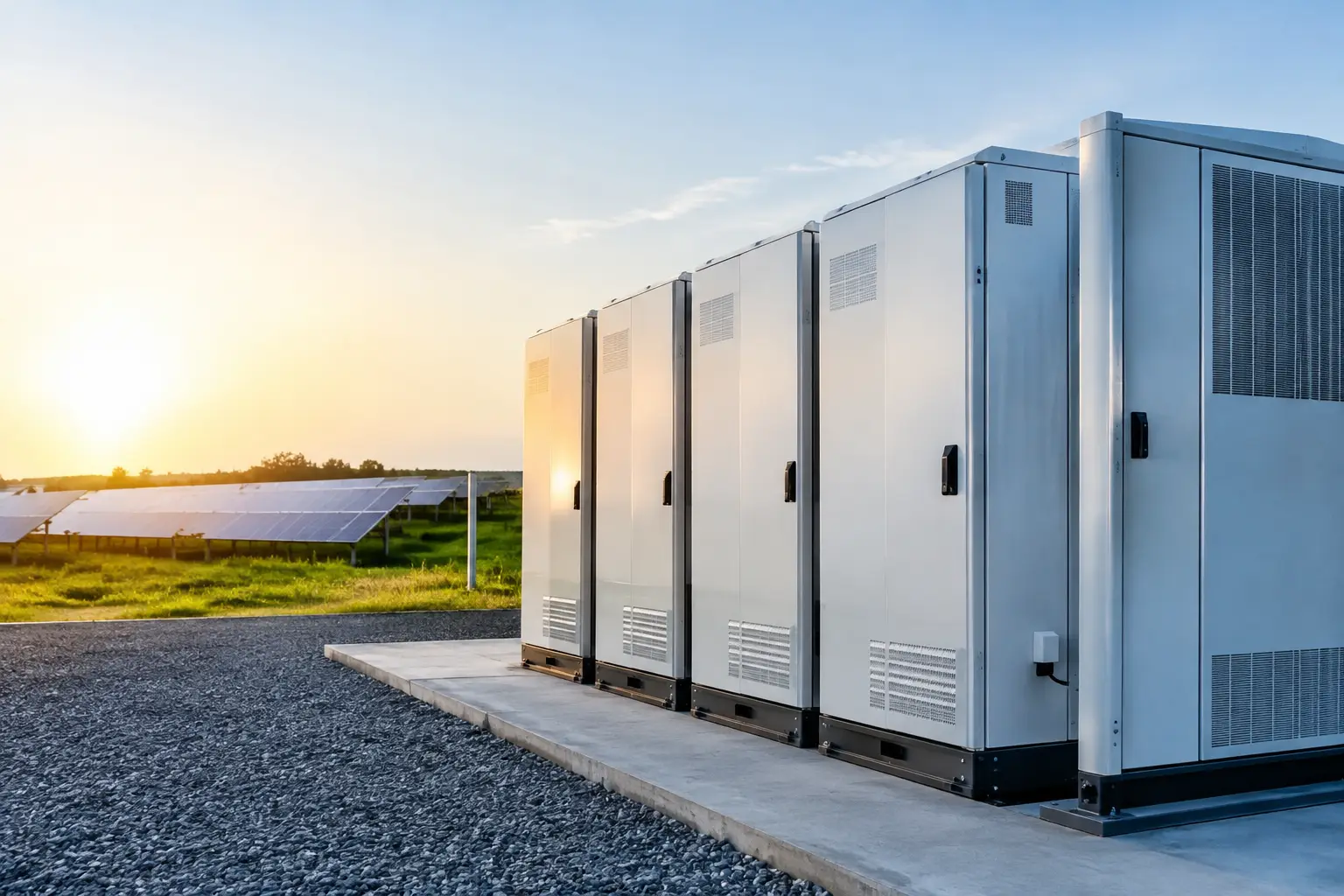
Commercial battery storage is serious electrical infrastructure. It should be installed by competent specialists who understand both the battery manufacturer’s requirements and the wider electrical installation. Positioning affects safety, performance and practicality: a battery may need adequate ventilation, protection from impact, a suitable fire strategy and clear access for maintenance and emergency services.
The system also needs to integrate correctly with the existing supply and protection arrangements. This includes appropriate isolation, labelling, earthing considerations and testing on completion. For sites with solar, EV charging, generators or heat pumps, the controls must be coordinated so equipment does not compete for limited supply capacity or create avoidable peaks.
Planning permission is not always required, but it can be relevant depending on the property, location, external equipment and any listed-building or lease restrictions. Landlords, insurers and facilities teams should be involved early. A well-managed project makes these conversations easier because the design, responsibilities and safety measures are documented from the outset.
Questions to ask before you invest
Before accepting a proposal, ask for a clear explanation of the assumptions behind the savings forecast. You should understand the electricity tariff used, the assumed export value, predicted solar generation, battery cycling pattern, degradation allowance and whether the forecast includes maintenance or finance costs.
Ask how the battery will behave on your specific tariff and whether controls can be adjusted if that tariff changes. Electricity contracts and operating hours do not stand still. A system with sensible monitoring and configurable controls is better placed to remain useful as the business changes.
It is also sensible to ask what is included beyond the battery itself. Does the price cover electrical upgrades, groundworks or mounting arrangements, communications equipment, commissioning, testing, staff handover and ongoing support? A low initial figure can become less attractive if key site work has been excluded.
Finally, establish who will take ownership of performance after installation. Commercial energy systems benefit from regular review, especially through the first year. Actual consumption may differ from the original model, solar output changes by season and a new EV charger or piece of machinery can alter the load profile quickly.
A joined-up approach for commercial sites
Battery storage delivers more value when it is considered alongside the whole electrical picture. A proposed solar array may need a different size once a battery is included. New EV charge points may create peaks that storage can help manage. An EICR, distribution-board upgrade or supply review may reveal the practical limits of the existing installation before new equipment is specified.
That joined-up thinking is particularly useful for developers and growing businesses. Designing solar, battery storage, charging infrastructure and core electrical works together is generally less disruptive than bolting each element on over several years. It also creates a clearer route for future expansion.
At SWH Electrical Solutions, the aim is to make that process straightforward: assess the site, explain the options in plain English, complete the electrical work properly and leave the client with a system they can understand and monitor. There is no benefit in promising a battery will solve every energy problem. The value is in designing one that suits the building, the tariff and the way the business actually operates.
A commercial battery is best viewed as a working asset, not a box of stored electricity. With good data, sound electrical design and realistic expectations, it can give your business more control over energy costs for years to come.