A request for one EV charger can quickly become a building-wide decision. To prepare flats for EV charging properly, freeholders, landlords and developers need to look beyond the parking bay and consider the electrical supply, ownership arrangements, future demand and how residents will pay for the electricity they use.
For a block of flats, the right answer is rarely to fit a single socket and hope for the best. A planned approach can avoid expensive rework, protect the building’s electrical capacity and give residents a fair, safe way to charge at home.
Start with the building, not the charge point
The first question is not which charger to buy. It is whether the building can support one now, and several more later.
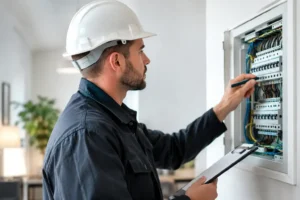
An electrical survey should establish the size and condition of the incoming supply, the available capacity at the main intake, the arrangement of landlord and individual flat supplies, and the likely route from the electrical intake to parking spaces. In many older blocks, the existing supply was designed around lighting, lifts, communal heating or a small number of landlord services. It may not have much spare capacity for multiple vehicles charging at the same time.
This does not automatically mean an upgrade is required. Smart charge points can manage demand by reducing or pausing charging when the building load is high. This is known as load balancing or load management. It can make EV charging viable where fitting several unrestricted chargers would overload the supply.
However, load management has limits. If a development expects high EV uptake, or if electric heating, heat pumps and battery storage are also planned, the distribution network operator may need to be involved early. A supply upgrade can take time and may affect budgets, so it is far better to identify the issue during design than after residents have started asking for chargers.
Prepare flats for EV charging with a phased plan
Not every parking space needs a live charge point from day one. In fact, fitting chargers for every bay immediately can be unnecessary where demand is uncertain. The more practical option is often to install the shared infrastructure first, then add individual charge points as residents request them.
A phased plan normally provides suitable containment, cabling routes, distribution capacity and communications infrastructure for future bays. The first chargers can then be connected with less disruption and without repeatedly digging up landscaped areas or reopening communal walls.
For a new-build scheme, this should be considered alongside the wider electrical design. Allowing for spare ways in distribution boards, appropriately sized submains and cable routes during construction costs considerably less than retrofitting them after completion. Requirements under Building Regulations can also apply to qualifying new buildings and major renovations in England, so the project team should confirm the position at an early stage.
For existing blocks, the route may be more complicated. Cables might need to pass through risers, service cupboards, underground ducts, car parks or external communal areas. Each route must be assessed for protection from damage, weather exposure, fire compartmentation and future access for maintenance.
Get permission and responsibilities clear
EV charging in flats often involves more people than a typical domestic installation. Depending on the building, consent may be needed from the freeholder, managing agent, residents’ management company, landlord or superior landlord. Lease terms may also set out who is responsible for alterations to communal property.
This is especially relevant where a resident has an allocated bay but does not own the land outright. An allocated space is not always the same as having the legal right to install equipment, run a cable across communal land or use the communal electrical supply.
Before work starts, agree who owns the charge point, who maintains it and what happens if the resident moves. A clear written policy prevents awkward disputes later, particularly if the charger is connected to a communal supply or installed within a shared parking area.
For larger developments, it can be sensible to set a standard specification for all future installations. This helps keep equipment compatible, avoids a patchwork of cable routes and makes electrical records easier to manage. It also gives every resident a consistent process for requesting a charger.
Decide how electricity will be measured and paid for
Billing is one of the main practical challenges when preparing flats for EV charging. A charger connected directly to an individual flat’s meter is usually the simplest arrangement because the resident pays for their own electricity through their normal tariff. That option depends on the parking bay being close enough to the flat’s supply, with a safe and practical cable route.
Where chargers are supplied from a landlord’s or communal meter, accurate metering becomes essential. The building owner should not be left covering a resident’s charging costs through the service charge. Charge points can be configured to identify users and record consumption, allowing the operator to recover the cost of electricity and, where appropriate, administration or maintenance costs.
The best model depends on the block. A small converted property with two or three flats may suit a simple arrangement. A larger development with visitor spaces, staff parking or dozens of residents may need a managed back-office system with access control, user accounts and reporting.
It is worth deciding this before choosing hardware. The cheapest charger is not always the most economical choice if it cannot support the way the building needs to bill, manage access or expand in future.
Make electrical safety and fire safety part of the design
EV charge points are substantial electrical loads and must be designed and installed to the relevant wiring regulations. A proper installation considers earthing arrangements, protective devices, cable sizing, isolation, fault protection and the effects of simultaneous use across the building.
In communal car parks and external spaces, physical protection matters too. A charge point may need bollards or a suitable mounting position to reduce the risk of vehicle impact. Cables should not create trip hazards or cross escape routes. Where services pass through compartment walls or floors, suitable fire stopping is required to maintain the building’s fire protection.
The installation should also be suitable for the environment. An open car park, underground basement and exposed coastal location all place different demands on enclosures, cable protection and fixings. A site survey is where these details are resolved properly, rather than treated as costly variations once work has started.
Residents also need a clear reporting route for faults or damage. A charger that is out of service, visibly damaged or repeatedly tripping should not be ignored simply because it is located in a shared area.
Choose technology that supports the building’s future
Smart charging is particularly valuable in blocks of flats. It helps spread demand across available capacity and can give residents the option to charge at cheaper off-peak times, depending on their electricity tariff. For a building owner, it offers a more controlled alternative to every driver plugging in at full power as soon as they return home.
Connectivity should be considered carefully. Some charge points rely on mobile signal, Wi-Fi or a hard-wired network connection. A basement car park with poor signal may need a different solution from an open courtyard. It is frustrating to install capable equipment only to find that the communications needed for monitoring or billing are unreliable.
There is also a choice between tethered and untethered units, wall-mounted and pedestal chargers, and standard or higher-power charging. The right option depends on parking layout, accessibility, resident needs and available electrical capacity. Faster is not always better if it drives up infrastructure costs without solving a genuine need. For most homes, vehicles are parked for several hours or overnight, so managed charging at a sensible rate can be entirely practical.
Plan for fair access, including visitor parking
A good EV charging policy should not favour only the first residents to apply. If capacity and cabling are limited, set out how requests will be prioritised and how future spaces will be funded. Transparency matters, particularly where service charges or communal assets are involved.
Visitor bays need their own consideration. A shared visitor charger can be useful, but it should not prevent residents from accessing their allocated spaces or create an unclear payment arrangement. In some developments, it may be better to reserve infrastructure for residents first and review visitor provision once usage patterns are understood.
Accessibility is another practical point. Positioning, mounting height, cable length and the route around parked vehicles can affect whether a charger is genuinely usable. Planning this from the outset is much easier than relocating equipment after a complaint.
Use an experienced electrical contractor from survey to commissioning
A block-of-flats EV project brings together electrical design, landlord responsibilities, shared infrastructure and long-term maintenance. Using a competent contractor means the survey can focus on the whole system, not just the charger on the wall.
SWH Electrical Solutions works with homeowners, developers and commercial clients across Newcastle and the North East, helping identify suitable charging arrangements alongside wider electrical, solar and battery plans. For new developments especially, bringing the electrical contractor into the conversation early can reduce delays and avoid unnecessary alterations later.
The most useful outcome is not simply a charge point in one bay. It is a safe, documented and expandable arrangement that gives the building a sensible route as more residents switch to electric vehicles. Plan the infrastructure once, and future charging requests become a managed upgrade rather than a fresh building project every time.