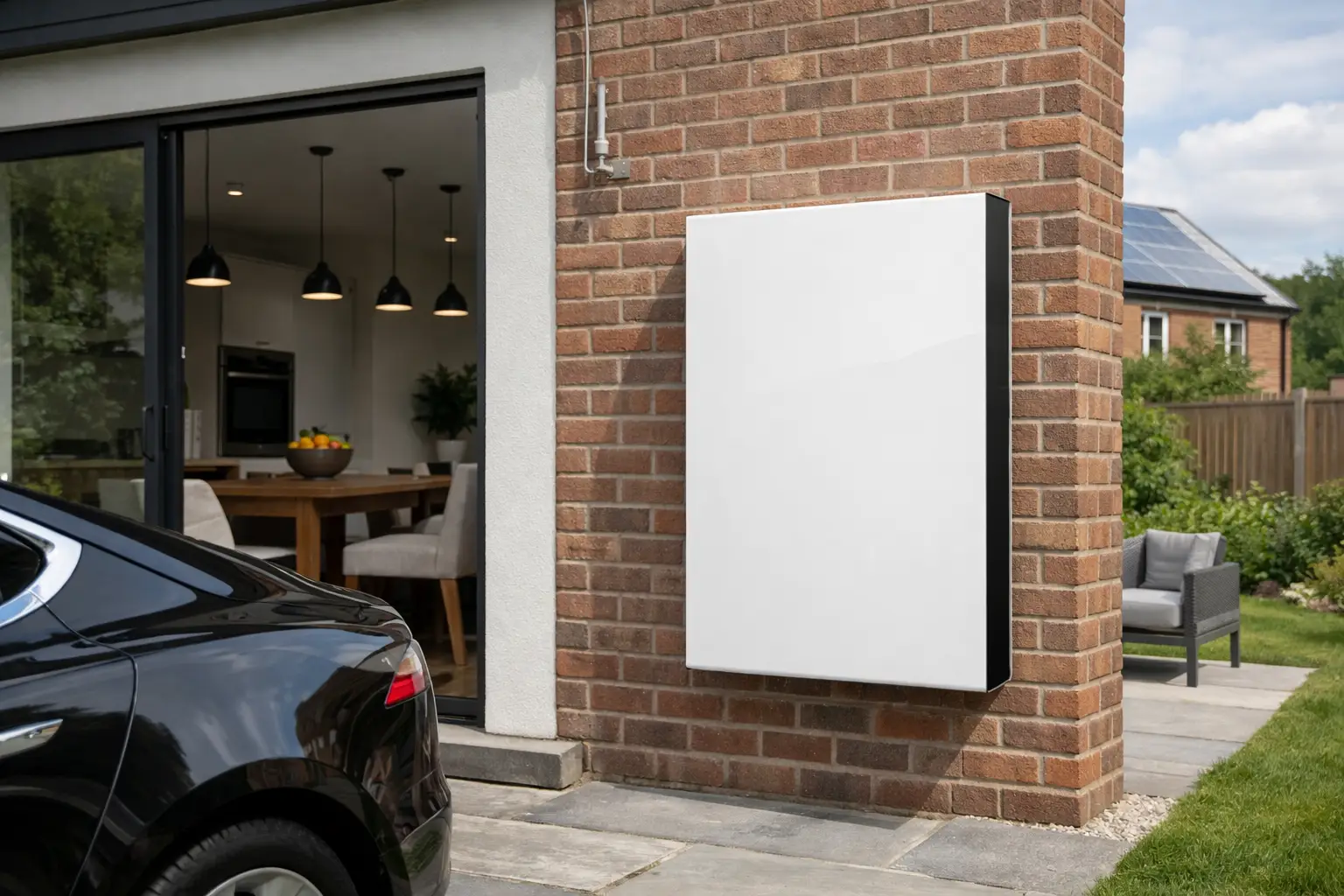
A home battery earns its keep in the hours when solar panels have stopped generating but your household has not stopped using electricity. For many households, that means cooking tea, charging an EV, running the washing machine and putting the heating controls through their evening routine. This Tesla Powerwall review UK looks at whether Tesla’s well-known battery is a sensible answer to that problem, rather than simply an expensive bit of kit to add to a solar system.
Tesla Powerwall review UK: the short answer
The Tesla Powerwall is one of the strongest all-round domestic battery options for UK homes with solar, particularly where the priority is high usable capacity, serious power output and the option of backup power during a cut. It is not automatically the best-value choice for every property. A smaller battery can make more financial sense for low-use households, while homes without solar need to be realistic about how quickly savings will build.
What sets Powerwall apart is that it is designed to do more than store spare solar. It can charge from the grid at cheaper off-peak times, support high-demand appliances, and, with the correct backup equipment and design, keep selected circuits or much of the property supplied if the grid fails. That is useful functionality, but it needs to be specified properly from the start.
What you get with a Tesla Powerwall
The current Powerwall 3 has 13.5 kWh of usable battery capacity. In plain terms, that is a meaningful amount of stored electricity for an average household. It could cover a typical evening and overnight base load, although the real result depends heavily on electric heating, cooking habits, EV charging and the size of the solar array.
Its high power output is a major selling point. Some batteries have plenty of energy stored but struggle when several appliances run at once. Powerwall is better suited to homes with larger electrical demands, such as induction hobs, heat pumps, EV chargers and busy family routines. Capacity tells you how long a battery can run; power tells you what it can run at one time. Both matter.
Powerwall 3 also incorporates a solar inverter, which can simplify the design of some new solar installations. For homes with an existing solar system, the most suitable arrangement depends on the inverter already in place, its age and how the battery will connect. There is no one-size-fits-all answer, which is why a proper site survey matters more than a headline specification.
The system is managed through the Tesla app. Owners can see generation, household consumption, grid imports and exports, and battery charge level. For customers who want to understand where their electricity is going, that visibility is genuinely useful. For those who would rather leave it alone, the system can be set up to prioritise self-consumption or charge around an off-peak tariff.
Solar savings: where the value usually sits
A solar-only home often exports electricity in the middle of the day, then buys power back from the grid after sunset. A battery changes that pattern by storing some of the daytime surplus for later. The more solar generation you can use in your own home, the less electricity you generally need to buy at standard rates.
That does not mean every unit stored is free. There are energy losses whenever electricity moves into and out of a battery, and winter solar generation in the North East can be modest. During darker months, Powerwall may be charged more often from the grid than from the roof. This is where a good time-of-use tariff can make a difference. Charging at a low overnight rate and using that electricity during more expensive periods can improve the battery’s value.
The strongest case is often a household that has solar, uses a fair amount of electricity after sunset and can shift some demand to cheaper tariff windows. An EV, heat pump or electric hot water setup can increase electricity use considerably, but it also increases the opportunity to manage that use intelligently.
A battery should not be sold as a promise of free electricity or total independence. UK winters, tariff changes and household behaviour all affect the figures. It is better viewed as a practical tool for buying less expensive electricity, making better use of your solar and reducing reliance on the grid at peak times.
Is backup power worth paying for?
Backup is one of the areas where Powerwall can be particularly appealing, but it is also where expectations need managing. A standard solar-and-battery installation does not necessarily keep a home powered during a power cut. For that, the installation needs the appropriate Tesla Backup Gateway and a design that safely disconnects from the grid.
The system can then supply the property, subject to the battery’s charge level and output limits. In many cases, an installer will discuss whether to back up the whole home or only essential circuits. Keeping lights, broadband, refrigeration, sockets and heating controls operating may be more sensible than trying to run every high-load appliance as normal.
For example, a Powerwall with a healthy charge can provide valuable reassurance during a short outage. It is not a licence to run an electric shower, oven, tumble dryer and EV charger without thought. Managing high-load equipment is part of a safe, reliable backup design.
Power cuts are not an everyday event for most homes, so backup alone may not justify the cost. However, it can carry more weight for households working from home, properties in areas with less reliable supply, or anyone with equipment that should not be left without power. It is a resilience feature, not just a financial calculation.
Tesla Powerwall costs in the UK
Installed pricing varies because the battery itself is only part of the job. The final quote can include the Powerwall, gateway equipment, electrical protection, cabling, installation labour, commissioning, notification to the Distribution Network Operator and, where required, changes to the consumer unit or meter arrangement.
A straightforward installation is very different from fitting a battery alongside a new solar array, upgrading an older electrical installation, or providing whole-home backup. Access, cable routes, the location of the battery and whether the property has single-phase or three-phase supply can also affect cost.
It is worth asking what is included rather than comparing one headline figure against another. A well-scoped quotation should explain the proposed system design, backup provision if requested, expected disruption, warranties and the approvals needed. MCS-certified solar work and competent electrical installation are particularly important where a system is being added to an existing property.
The practical points that can make or break the installation
Powerwall is usually wall-mounted, although suitable floor mounting may be possible depending on the design. It needs a location with adequate space, a safe cable route and consideration for ventilation, access and weather exposure. Garages and utility areas are common choices, but every property is different.
The existing electrical installation also deserves attention. A battery connects into the heart of the home’s electrical system, not as an afterthought. Older consumer units, limited space around the meter or poor-quality previous work can add complexity. Sorting these issues before commissioning avoids disappointment and keeps the installation compliant.
Grid approval is another point that should be handled properly. Depending on the system’s export capability and the local network, the installer may need to notify the DNO or obtain permission before installation. This is not glamorous, but it is essential. An experienced installer should manage the technical paperwork and explain any limitation placed on export.
For North East homeowners, local aftercare is worth weighing alongside the product itself. A battery is intended to operate for years, so it helps to have an installer who can support the wider solar and electrical system rather than treating the job as a one-day fitting. SWH Electrical Solutions takes that joined-up approach, from survey and design through to installation and commissioning.
Who should choose a Powerwall – and who may not need one?
Powerwall is a good fit for households with a reasonably sized solar array, substantial evening electricity use and a desire to use tariff-based charging. It is also well suited to homeowners who value backup capability and have the electrical demand to make use of its power output.
It may be more battery than a small household requires if daytime occupancy is high, electricity use is modest and there is little solar surplus to store. In that situation, a lower-capacity battery could deliver a better return. Equally, if the main aim is emergency backup, it is worth pricing the gateway and design carefully rather than assuming it is included.
For larger homes, all-electric properties and households planning an EV or heat pump, Powerwall can be a sensible way to future-proof the energy setup. The key is to size the system around actual consumption data, not around a neighbour’s installation or a tempting online offer.
The best next step is to look at your half-hourly electricity use, solar generation and tariff options together. A battery should fit the way your home really runs – including those dark January evenings when the kettle, cooker and car charger all seem to want power at once.